
AI Branding Optimisation: The Visibility Stack
The "AI branding" market is mostly noise. Here's the part that isn't.
The pitches landing in our inbox right now are wild. "GEO." "AEO." "Get cited in ChatGPT." "Rank in Google's AI Overviews." Half of it is rebranded SEO. The other half is genuinely new — and almost nobody's selling that part. This is the version that's actually useful if you're running marketing in 2026.
What's new, briefly
OpenAI shipped shopping inside ChatGPT. Google's AI Overviews are now triggering on more queries than not. AI Mode is rolling out wider. Perplexity keeps tweaking how it sources. And there's a wave of new tools — Profound, Peec, Athena, Otterly — all selling some flavour of "track your brand across LLM answers."
What they're all reacting to: the surface where a buyer can "find" you has fragmented. Google's not the single chokepoint anymore. A real Dubai buyer journey now looks like — ask ChatGPT for the best clinic in JLT, check Perplexity for sources, then hit Google to verify the phone number.
But here's where the noise gets loud. Almost every vendor pitch fixates on one thing: getting cited. That's the visible layer. It's also the shallowest.
AI branding is a stack, not a checklist
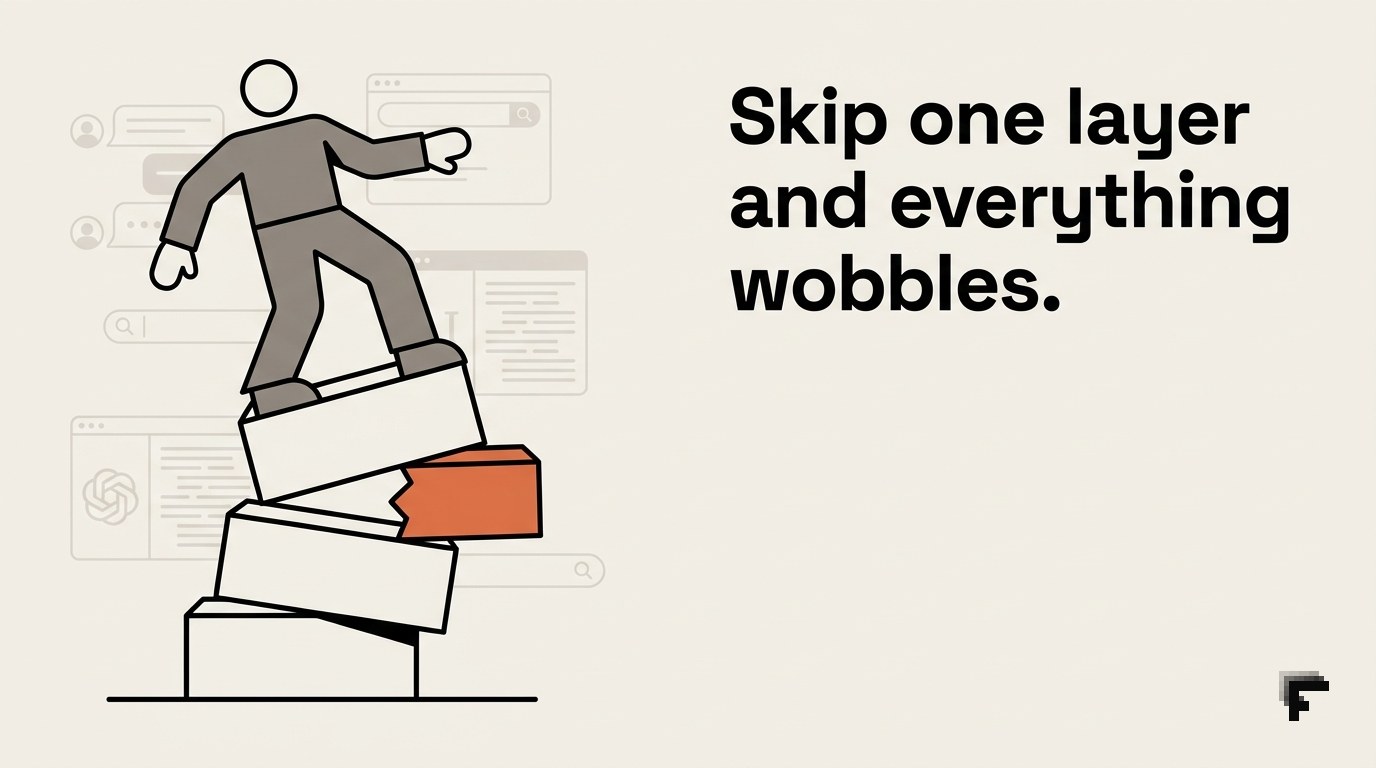
If you're going to spend money on this, the only framing that holds up is layered. Four layers, each feeding the one above it. Skip a layer and everything above gets wobbly.
Layer 1 — Entity foundation. Does the model know you exist as a thing, and what category you belong to? Wikidata. Wikipedia. Structured data. Consistent NAP across the web. Crunchbase. LinkedIn. Third-party mentions that pin you to a concept. If the model can't fix you to an entity, nothing above this layer matters. Most GCC agency sites fail here and don't realise it.
Layer 2 — Corpus presence. Is your content actually in the training data and the live retrieval index? This is where classic SEO still does most of the lifting — crawlable, clean, answers real questions, quoted on sites the models trust. Reddit, YouTube transcripts, vertical publications, forum threads — all carry more weight than they did two years ago.
Layer 3 — Answer shape. When the model writes its answer, does your content fit the format it wants? Lists. Comparisons. Definitions. Step-by-steps. A direct answer in the first 100 words. This is the layer the "GEO" tools obsess over. It's real, but it's a tactic dressed up as a strategy.
Layer 4 — Brand gravity. Are people searching for you by name? Talking about you? Linking unprompted? This is the hardest layer to fake and the one that compounds. Models lean toward brands with signal density around them — and there's no schema markup that fakes that.
Two things to internalise. You can't prompt-engineer past a missing Layer 1. And you can't schema your way into Layer 4.
How to figure out where you're actually weak
Before buying any new tool, run this audit yourself. We do it on every client onboarding.
1. Ask the LLMs directly. Search your brand in ChatGPT, Claude, Gemini, and DeepSeek (or Perplexity if your buyers lean western). Note what each one gets right, wrong, or invents. That's your baseline.
If doing this by hand feels like a chore — we built [a free tool]() that does it in under a minute across all four engines with web search enabled. The output is split into three numbers, not one: Real AI Visibility (broad "best in industry" queries), Product-Level Visibility (niche / community / category positioning), and Echo Rate (when we name your brand directly). The split tells you which layer of the stack is actually failing — low echo means Layer 1 (the model doesn't know you exist), low real-AIVS with high echo means Layer 2 / 4 (you exist but you don't show up organically), and so on.
2. Check your Wikidata entry. No entry = Layer 1 problem. Fix that before anything else. It's free and takes an hour.
3. Pull your top 20 commercial queries. Ask each LLM. Are you cited? Is a competitor? Is the answer pulling from a source you could realistically be on?
4. Audit your schema. Organization, Product, FAQPage, Article. Boring, basic, still working.
5. Find the 5 third-party sites the models keep quoting in your category. Get on them. Guest posts. Interviews. Listicles. Reddit AMAs. YouTube features. If every "best brokerage in Dubai" answer cites one Bayut editorial and you're not in it, that's the gap.
None of this is glamorous. None of it is a "GEO hack." It's the same discipline that's always worked — entity clarity, corpus presence, content quality, brand demand — applied to a wider set of surfaces.
The point
Getting cited in an AI answer is a lagging indicator, not a strategy. If your entity is fuzzy and your brand gravity is thin, no amount of answer-shaping will hold for long.
Build the lower layers first. The citations follow on their own.
If you want to see where you sit on the stack today, run the check. Takes a minute, three honest scores, per-engine breakdown, and the raw LLM responses so you can read exactly where your name landed — or didn't.
Written by Khmer. Start a project →