
LinkedIn Predictive Audiences three months in: the performance pattern
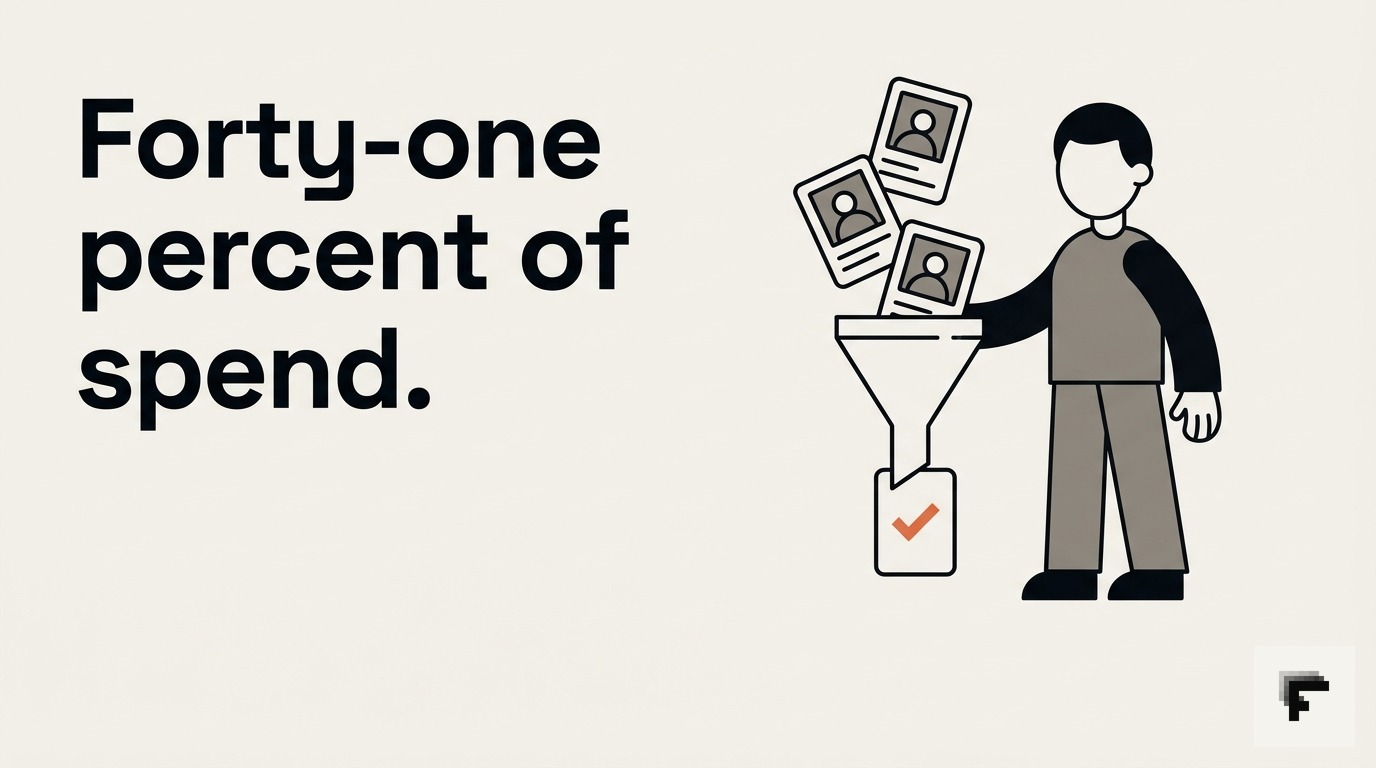
LinkedIn Predictive Audiences went GA in 2025 and now power roughly 41% of Sponsored Content spend. Three months into mass adoption, the performance pattern is clear, and so is the gap between accounts that gained and accounts that did not.
LinkedIn Predictive Audiences went GA in 2025. By Q1 2026, they powered roughly 41% of Sponsored Content spend across the platform (LinkedIn Marketing Solutions disclosures, Q1 2026). Three months into mass adoption, the performance pattern is clear, and so is the gap between accounts that gained CPL and accounts that watched the change pass without movement.
Early industry benchmarks place CPL reductions at 20-40% for Predictive Audiences against manually-built lookalikes, with the strongest lift on accounts that fed the model rich conversion data from the start. The weaker lift sits on accounts that connected the system but never gave it clean signal to learn from. Same product, two distributions, and the variable that explains the spread is conversion data hygiene, not creative or budget.
Three patterns separate the cohorts.
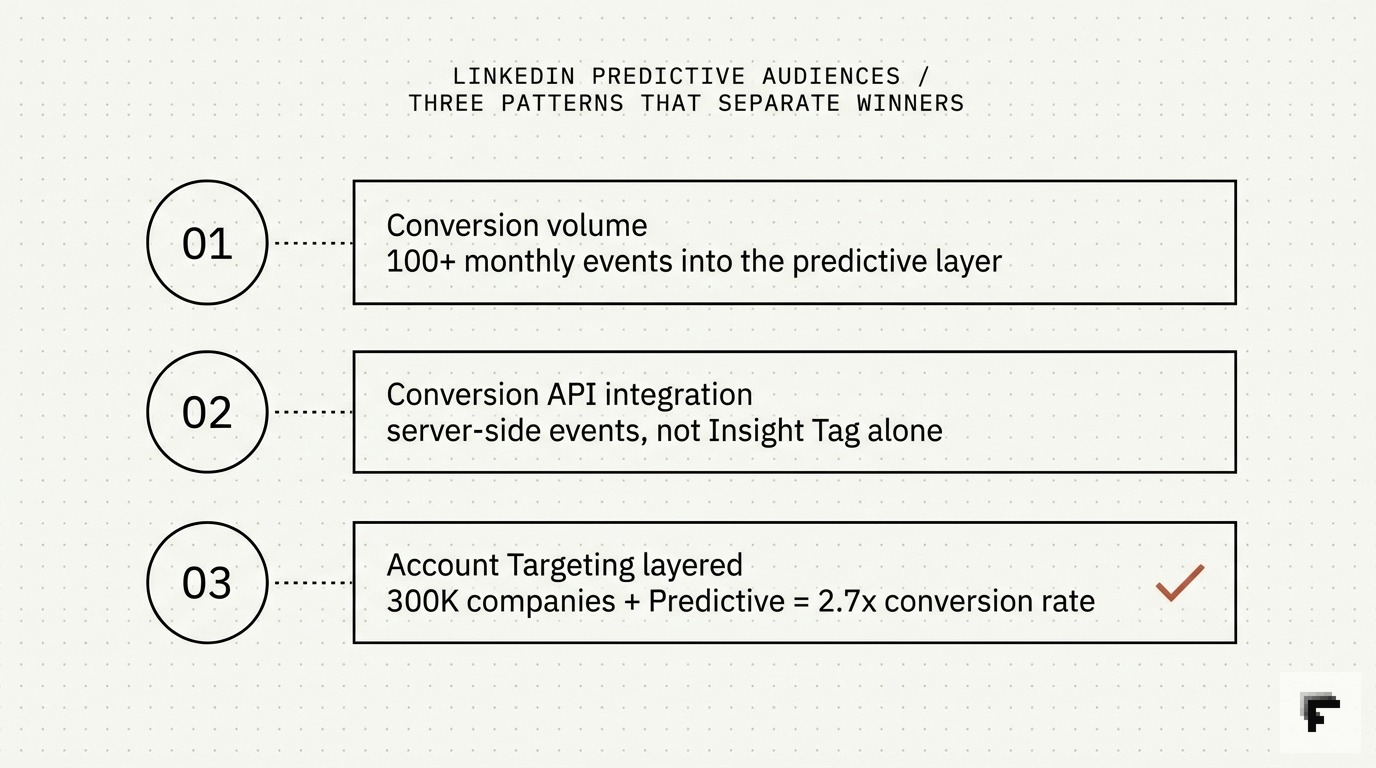
Pattern one. Conversion volume into the predictive layer. Accounts feeding the system 100+ MQL or SQL events per month inside a single objective converge fastest. Below 50 events, the model spends most of the learning window on exploration rather than exploitation. The 4-6 week learning floor LinkedIn quotes for Predictive Audiences only holds if there is real conversion signal flowing in. Accounts running Predictive on top of a CRM integration that fires once a quarter are not actually using the feature.
Pattern two. Conversion API integration, not Insight Tag alone. The Insight Tag still works, but the Conversion API surface LinkedIn shipped in 2024 fires server-side events that bypass the cookie attrition Predictive Audiences would otherwise suffer. Accounts on Insight-Tag-only setups are reporting roughly 30-40% of the conversion volume the CAPI-equivalent equivalent setup captures. The data gap shows up directly in Predictive Audience performance because the model learns from what it sees.
Pattern three. Account Targeting layered on top. ABM-style Account Targeting (up to 300,000 companies uploaded) combined with Predictive Audiences inside the same campaign performs 2.7x better on conversion rate than industry-plus-seniority targeting alone (industry agency benchmarks, 2026). The two systems are complementary, not redundant. Predictive Audiences narrows on conversion-likely individuals. Account Targeting narrows on the right companies. The Venn intersection is where most B2B SaaS shortlist decisions actually live.
Implementation moves that compound
Four operational shifts separate the accounts pulling CPL down from the ones holding steady.
Give the system a 4-6 week learning window before judging it. Predictive Audiences need genuine signal density before they converge. Accounts that switch back to manual targeting after two weeks because "performance dropped" are bailing on the convergence phase, not on the underlying model. The drop in week two is expected. The recovery in week four is the signal.
Track conversion data quality the same way ad accounts track creative refresh rate. If MQLs are flowing in with missing company-domain fields, the model is learning incomplete patterns. A dirty CRM pipeline upstream produces a confused Predictive Audience downstream.
Layer ABM where the seed audience is large enough to compound. For accounts with target lists under 5,000 companies, Account Targeting alone often outperforms the combined approach because the audience is already narrow enough. For 5,000+ company target lists, Predictive Audiences plus Account Targeting consistently wins.
Audit the form-fill side. LinkedIn Lead Gen Forms have a 5-10% form-completion advantage over off-platform landing pages, but only when the field set is short and the value exchange is honest. Predictive Audiences will not save a long form with a vague value prop, no matter how well the targeting layer performs.
The bigger picture is that LinkedIn Ads in 2026 has stopped being a job-title-and-seniority game. The targeting layer is now AI-driven, the integration layer is server-side, and the campaign layer is closer to operational discipline than to manual segmentation. Teams that treat Predictive Audiences as a checkbox setting will see modest lift. Teams that treat it as a system that needs feeding will see the 30-40% CPL improvements the early adopters are reporting. Same feature, two paths, the difference is whether the conversion pipeline upstream actually delivers what the audience layer needs.
Written by Foreground Digital. Start a project →