
Meta custom audiences now retain 730 days: what changes
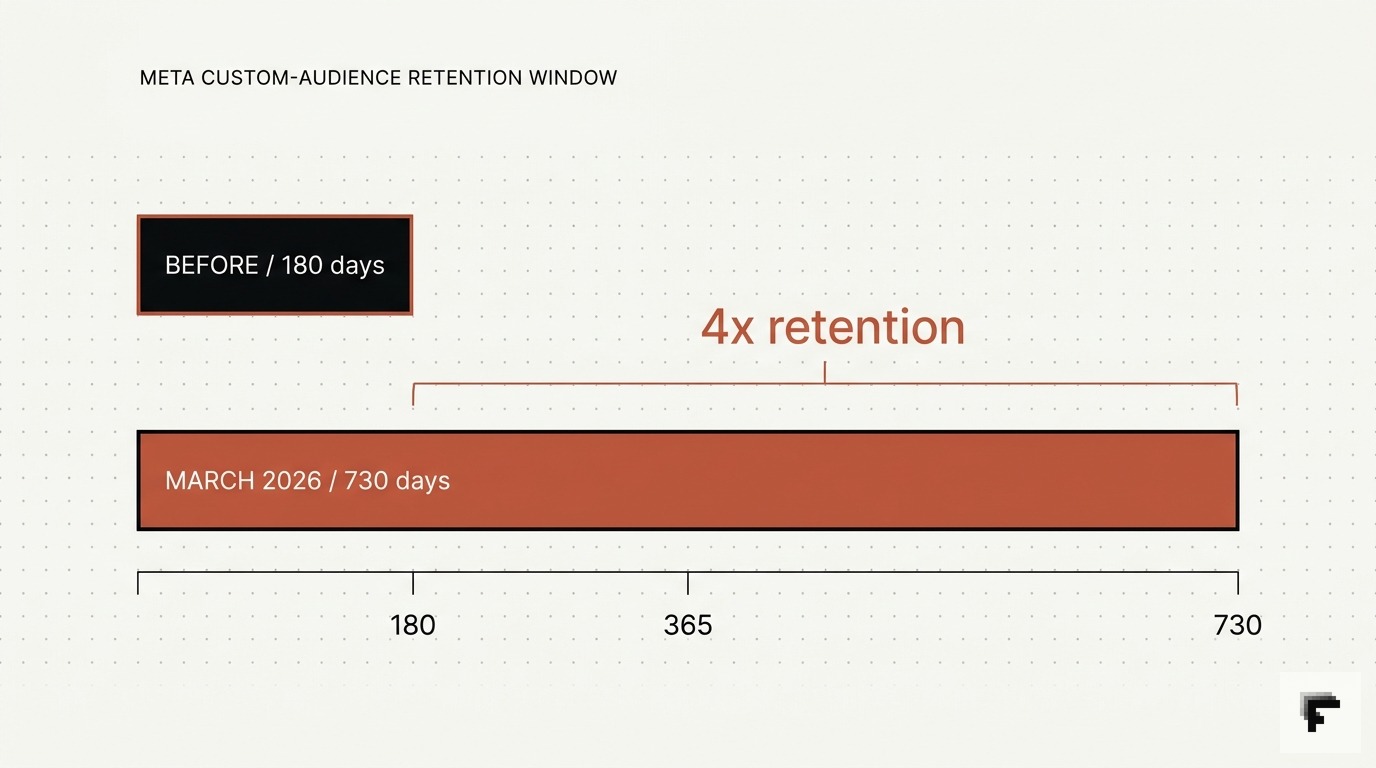
Meta quietly extended the maximum custom-audience retention window from 180 days to 730 days. The change passed without a launch event but materially rewires the math for any vertical with a buyer journey longer than six months.
Meta quietly extended the maximum retention window for custom audiences built from the Purchase event. 180 days to 730 days. The change shipped in March 2026 (Meta Ads platform release notes, March 2026). The cap on website-traffic custom audiences moved with it. No launch event, no blog post, no announcement at the top of Ads Manager. But the change materially rewires the math for any vertical where the buyer journey runs longer than six months.
The 180-day cap was a structural constraint for B2B SaaS, luxury real estate, education, financial products, automotive, and most enterprise sales motions. Lookalike sources had to be refreshed at six-month intervals or the seed aged out. Retargeting windows had to be cut short of the actual decision window. Long-cycle verticals were running paid acquisition on a tracking architecture designed for impulse purchases.
730 days changes that.
A Dubai brokerage selling AED 8M apartments to international HNW buyers can now retarget the same visitor 18 months into the consideration cycle, with the engagement history intact. A B2B platform with a nine-month sales cycle keeps every form-fill and pricing-page visit inside the active audience for the full window plus a year of post-close upsell. A university running paid enrollment campaigns covers two full academic-year decisions per audience refresh.
Three patterns shake out from the change.
First. Lookalike refreshes go from twice-yearly to once every two years. The operational overhead of audience maintenance drops. The seed audience becomes more reliable as it accumulates. Sites running server-side CAPI cleanly for the last six months are sitting on a much richer dataset than they realised. Every conversion captured now stays inside the audience for four times longer than the architecture assumed.
Second. The case for clean tracking gets stronger, not weaker. The longer the retention window, the more painful any conversion lost to the iOS-ATT gap becomes. That missed event is now absent from the audience for two years instead of six months. Brands that have not yet run the Meta Pixel and CAPI auditor checks are accumulating a slower-decay version of the same data hole. The retention extension is a multiplier on tracking hygiene, not a substitute for it.
Third. The long-cycle vertical playbook changes. Brokerages exporting Meta lead-ad CSVs to a separate CRM are giving up the retention they just gained. Every CSV export bypasses the conversion pipeline. The integration call is now a bigger one.
What to do with the new window
The defensive moves are obvious. Audit the custom-audience setup to confirm the new cap is being applied (Meta did not auto-extend existing audiences, only new ones built post-March). Rebuild the seeds with the longer window. Push lookalikes off the old refresh schedule onto the new one.
The offensive moves are more interesting.
Long-cycle nurture journeys impossible at 180 days are possible at 730. A Dubai brokerage can run a 12-month sequenced retargeting campaign across the consideration cycle, with creative variants per stage, without the audience aging out. A SaaS platform keeps trial signups inside an active upsell audience for two years post-trial. An automotive brand retargets a test-drive visitor across two model years.
The constraint on long-cycle nurture used to be the audience, not the creative. That constraint just got relaxed by a factor of four. Teams that re-architect their funnel against the new window, rebuild their lookalike refresh cadence on a once-every-two-years schedule, and pair the longer retention with a clean CAPI install will compound advantage over the next two years. Teams that flip the setting and walk away will leave most of the new range on the table. The audit is the first step either way.
Written by Foreground Digital. Start a project →