

ABM platforms are losing ground to LinkedIn Account Targeting
Dedicated ABM platforms (Demandbase, 6sense, Terminus) had a real edge for years. LinkedIn Account Targeting closed most of the gap in 2025-2026. The economics no longer favour the standalone vendor for mid-market B2B.
For most of the 2020s, account-based marketing was a software category. Demandbase, 6sense, Terminus, RollWorks, and a handful of others sold dedicated platforms at $50K-150K per year (Forrester ABM platform analysis, 2025). The pitch was straightforward. Buy our software because nobody else can give you company-level targeting, intent data, and ABM campaign orchestration in one place.
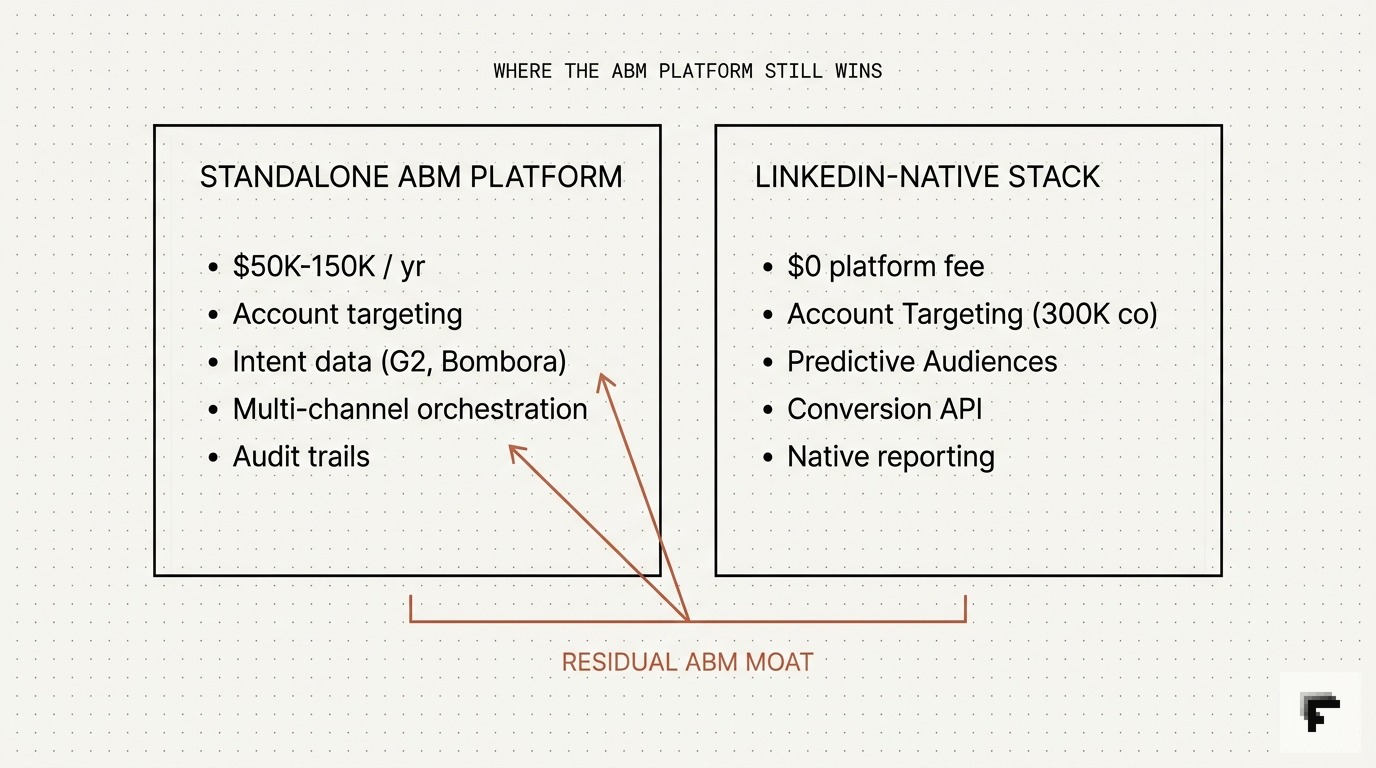
That pitch has stopped landing for a growing share of mid-market B2B buyers. LinkedIn Account Targeting now supports company lists of up to 300,000 organisations per audience (LinkedIn Marketing Solutions, 2026). Paired with Predictive Audiences and the Conversion API, the LinkedIn-native stack covers most of the targeting and orchestration value the dedicated ABM platforms charged for. The intent-data layer is still the ABM vendors' moat, but for many teams the moat is no longer worth $80K a year.
Three things shifted underneath the category.
Account list size caps lifted. LinkedIn Account Targeting moved from a 30,000-company ceiling in 2023 to 300,000 in 2025. Most ABM target lists never exceeded 5,000 to 15,000 priority accounts anyway, so the cap stopped binding for almost every mid-market team. The "you need a dedicated ABM platform to handle large account lists" argument lost its anchor.
Predictive Audiences absorbed half the segmentation work. The targeting layer ABM platforms built their UX around (industry, employee count, revenue band, tech stack, intent score) is exactly what Predictive Audiences now learn from clean conversion data. A LinkedIn campaign feeding the model genuine MQL signal narrows on the right cohorts without a separate platform managing it.
Conversion API closed the tracking gap. ABM platforms used to have a real advantage in attribution because they ran their own pixel and their own cross-domain identity resolution. LinkedIn's Conversion API surface (live since 2024) fires server-side events that hold attribution through cookie attrition, ATT, and consent banners, much the way Meta's CAPI does on the consumer side. The attribution moat shrank.
Where the standalone ABM platform still wins
Three use cases keep the standalone-platform spend defensible.
The first is intent data sourced from third-party signal networks (G2, TrustRadius, Bombora). ABM vendors aggregate buying signals from review platforms, content syndication networks, and ad-exchange impressions in ways LinkedIn cannot. A team that genuinely uses intent data to time outreach (versus using it as a checkbox feature) will get value from the dedicated vendor that LinkedIn cannot replicate.
The second is multi-channel orchestration across email, ads, sales outreach, and content. Mid-tier ABM platforms have weak orchestration. Top-tier ones (Demandbase, 6sense at full enterprise tier) have credible orchestration that ties LinkedIn ads to email sequences to sales triggers. If the team has the operations capacity to use the orchestration layer, it pays back. If it does not, the orchestration tab gets opened twice a quarter.
The third is the enterprise audit trail. Regulated industries (finance, healthcare, government contracting) often need vendor-of-record purchasing, SOC 2 documentation, signed DPAs, and audit logs that an ad-platform-only stack cannot provide. The ABM platform becomes a procurement-clearing tool as much as a marketing one.
The decision most mid-market B2B teams should make
For a B2B account with 3-15 sales reps, an $80K target account list, and no dedicated intent-data analyst, the standalone ABM platform is a $50-150K cost that increasingly buys things the LinkedIn-native stack already delivers. The Advantage+ vs Detailed Targeting decision tree for Meta applies here in mirror image. Use the native AI layer where it works. Pay for the dedicated platform only where the gaps are real and the operations team has the capacity to close them.
The big ABM vendors will not collapse. They will move upmarket, where intent data and orchestration genuinely justify the price tag, and consolidate on the largest enterprise accounts. The mid-market category that bought the platforms for "we need ABM software" is the one quietly migrating to a LinkedIn-plus-CRM stack with no platform between them. The economics are forcing the move whether anyone announces it or not.
Written by Foreground Digital. Start a project →