
Agentic AI in the UAE: what the national project means for businesses
The UAE published its national agentic AI direction in 2025 and started funding the operationalisation through 2026. Here is what changes for businesses operating in Dubai and Abu Dhabi, and the practical asks already showing up in procurement cycles.
The UAE has been positioning artificial intelligence as national infrastructure since 2017, when the AI Strategy and the appointment of a Minister of State for AI signalled the direction. The 2025-2026 phase shifted the conversation from "AI" generically to "agentic AI" specifically. The distinction is structural, not branding. Agentic AI describes systems that can plan, act, and adapt across multiple steps with limited human supervision. The UAE's positioning is that the next decade of national productivity depends on rolling these systems out across government services, financial infrastructure, healthcare, education, and the private sector that supplies them.
That positioning translates into three practical asks already showing up in procurement cycles, hiring posts, and tender documents.
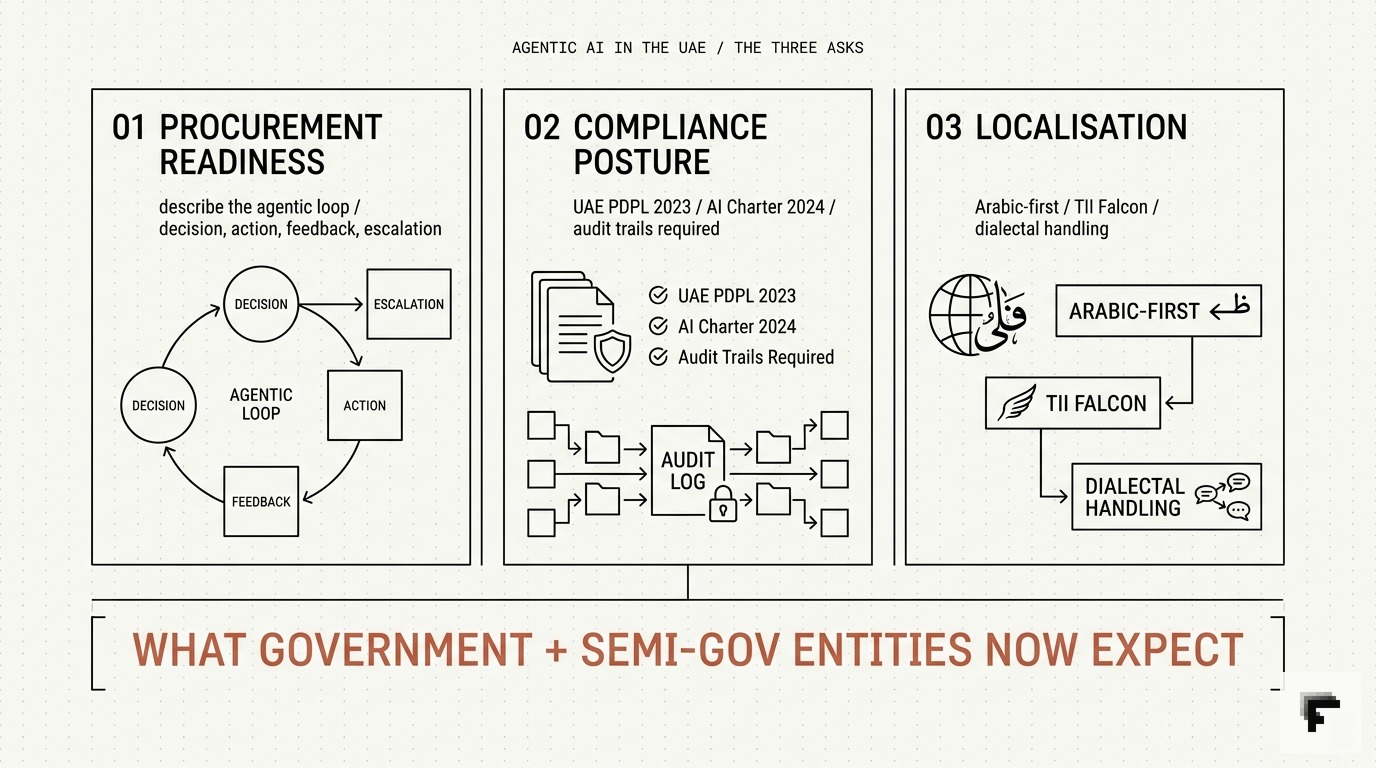
Procurement readiness. Government and semi-government entities operating in the UAE are increasingly asking suppliers to demonstrate agentic AI capability, not just AI assistance. The difference matters. A traditional RFP would ask for "AI-powered" reporting. The 2026 versions ask for "autonomous agents capable of monitoring [X], triggering corrective actions in [Y], and escalating to human reviewers when [Z]." Vendors that cannot describe the agentic loop concretely (the decision step, the action step, the feedback step, the escalation criterion) are being filtered before the technical evaluation.
Compliance posture. The UAE Personal Data Protection Law (PDPL, enforced 2023) and the new AI Charter (2024) impose specific requirements on automated decision-making. Agentic systems that take action affecting consumers (loan approvals, hiring filters, healthcare prioritisation) must publish their decision logic, accept human-review escalation, and maintain audit trails. The compliance load is meaningful but not unique to the UAE; the difference is that local enforcement has moved faster than in most of the GCC, and audits are happening rather than being discussed in committee.
Localisation. Arabic-language agentic AI performance lags English by a noticeable margin across most off-the-shelf systems. The UAE's strategy explicitly funds Arabic-first AI development, and Falcon (the TII-developed Arabic-capable LLM) is the most visible artefact. For businesses operating in the UAE, the practical implication is that pure imports of US-built agentic systems are partial solutions. Localisation work (Arabic-language fine-tuning, dialectal handling, cultural-context grounding) is increasingly expected by regulators and by enterprise buyers.
What this means for businesses planning their next quarter
Three operational moves separate businesses adapting to the direction from businesses watching it pass.
Map the agentic-AI use cases inside the operation that have measurable ROI in a 90-day window. Customer service triage. Lead qualification routing. Document verification (a Foreground portfolio company already does this for Dubai brokerages through Sijil). Compliance pre-screening. The cases with concrete throughput metrics produce a defensible board-level pitch; the abstract ones produce slide decks.
Hire or contract for the specific role of "AI operations engineer", not "AI strategist". The bottleneck on agentic adoption in 2026 is not strategy. The bottleneck is the engineer who knows how to design the decision loops, integrate with internal data systems, monitor drift, and run the on-call rotation when an agent makes a wrong call at 2am. The strategy hires were the 2022 pattern. The ops hires are the 2026 pattern.
Treat the procurement-readiness conversation as inseparable from the AI brand visibility one. Government buyers and enterprise procurement teams increasingly research vendors via ChatGPT and Gemini before issuing an RFP. A business that cannot describe its agentic capabilities and cannot be found through AI search ends up filtered out twice, at different stages, by the same underlying gap. The remediation is operational, not promotional.
The UAE's national positioning is real, the procurement signals are credible, and the timeline through 2027 is compressed enough that the early-mover advantage compounds inside the next eighteen months. Businesses that build agentic capability into the operating plan now will be competing for the contracts. Businesses that watch the policy announcements and wait for the dust to settle will be applying to subcontract on those contracts.
Written by Foreground Digital. Start a project →