
Fixing brand invisibility in LLMs (Google rank is not enough)
Brand invisibility in LLMs is the version of SEO failure your Search Console will never show you. ChatGPT, Gemini, Perplexity, and Claude are quietly recommending competitors in your place, and the fix has almost nothing to do with your Google rank.
Brand invisibility in LLMs is the version of SEO failure your Search Console will never show you. Forty-eight percent of Google searches now show an AI Overview at the top (Launchcodex analysis of Google's May 2026 core update), and when one appears, the top organic result's click-through rate drops from 28.5% to 11.2% (The Slide Factory, 2026). You still rank. You just earn 60% fewer clicks.
That is the polite version. The harder version is that the search itself has moved off Google for a growing share of buyers, who ask ChatGPT, Gemini, Perplexity, or Claude before they ever open a search tab. ChatGPT alone serves around 800 million weekly active users (OpenAI, 2026). Gemini sits north of 750 million monthly (Google, 2026). They answer the same intent traditional SEO was designed to win, only the answer comes back as a verdict rather than a list of links.
The real ranking question in 2026 is not "where do I sit on Google for [keyword]?" It is "what does the model say when someone asks it for the thing you sell?"
Call this the recommendation gap. Most Dubai brokerages that rank page 1 for "property management Dubai" do not get named when a buyer asks ChatGPT for property management firms in the city. A clinic with a strong Google Business profile can be invisible on Perplexity, where a competitor's blog wins the citation. An e-commerce brand crushing Performance Max can be recommended by Gemini in markets where its US parent is dominant, while the local UAE entity disappears from the answer entirely.
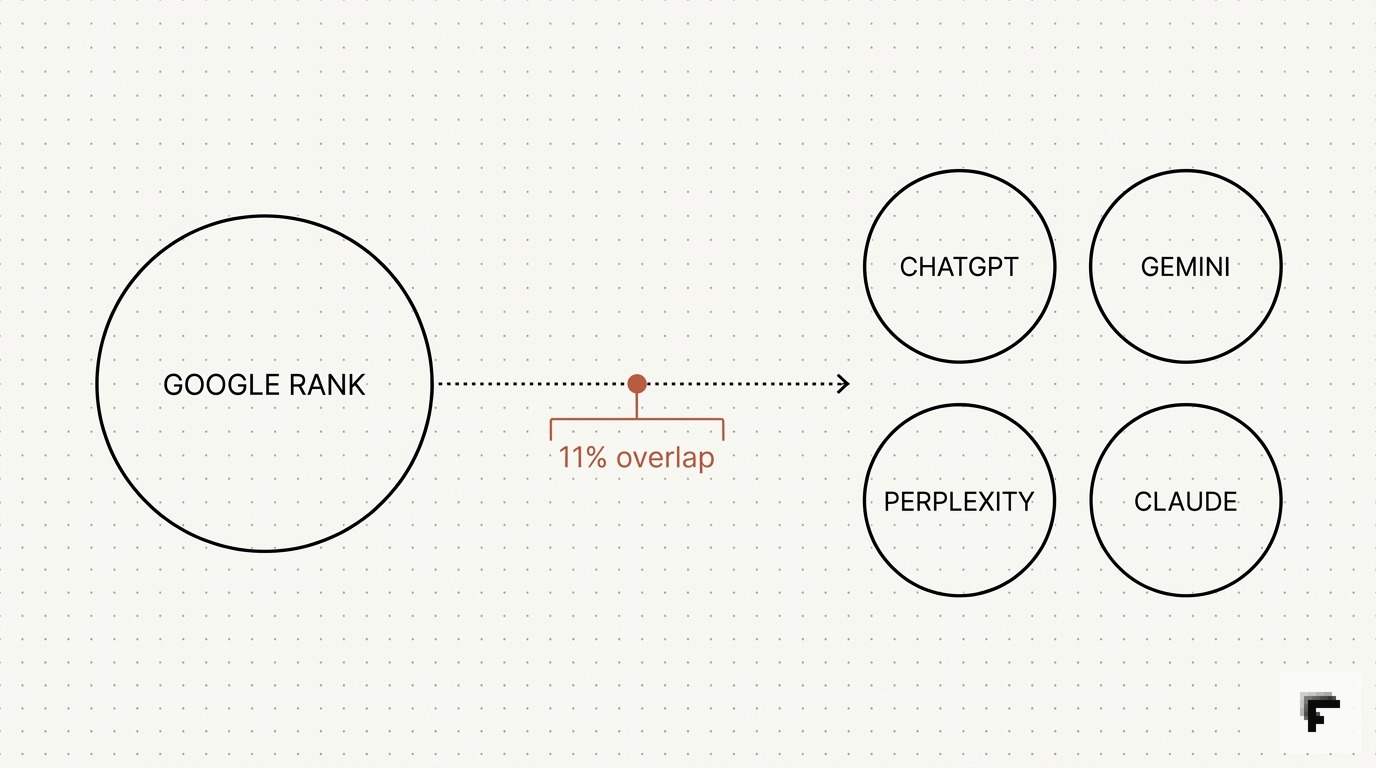
The mechanics are not mysterious. AI engines retrieve, they do not rank. They learn through pattern density: the same brand, described in the same way, appearing across a wide enough mix of trusted sources that the model concludes this is a real thing worth surfacing. Wikipedia accounts for roughly 47.9% of ChatGPT's top citations (Frase aggregated citation data, 2025). Perplexity, by contrast, rewards recency and source diversity, with only 11% overlap with ChatGPT's preferred domains (Enrich Labs GEO study, 2026). The weekly AI brand visibility dataset Foreground publishes for the GCC region breaks the same dynamic down by engine and industry, if you want to see where the scoring lands market by market.
That last number is the punchline. Ranking on one AI engine guarantees almost nothing on another. Each one has its own selection logic, its own preferred trust signals, its own quietly evolving editorial taste, and the market is splintering into at least five competing destinations rather than consolidating into one.
The brand invisibility audit you have never run
Fixing brand invisibility in LLMs deserves its own workstream from SEO, not a bolt-on. The full visibility stack sits across entity associations, third-party mentions, structured citations, and brand-name density in trusted corpora. The measurement layer (mention share, sentiment, co-citation with competitors) is different too, and the repair playbook (PR-style placements, schema, content built to be quoted rather than just ranked) has nothing in common with on-page SEO. The classic levers have not gone anywhere. Keywords, backlinks, page speed are still the entry ticket: 92% of citations inside Google's AI Overviews come from domains already ranking in the organic top 10 (Search Engine Land, 2026). But ranking is no longer the finish line. It is the start of a second race the SEO team is rarely briefed for.
If you have never checked whether the models mention your brand at all, that is the first move. The free AI Brand Mention Checker runs the same questions a buyer would, against the four major engines, and shows you exactly when your brand surfaces, when a competitor surfaces in your place, and how each mention is framed. It takes about a minute. Most brands that go through it the first time are quietly surprised at the gap between their Google position and their AI presence.
Google has not gone away. It just stopped being the only place the search ends. If the models do not know who you are, you are losing a category of traffic that does not show up in any Search Console report, and won't, until you go looking for it. If you want it fixed at the foundation rather than patched at the surface, the AI Visibility Foundation Fix is the 14-day scope, with every deliverable listed on the page: entity graph, Wikidata QID, schema, AI crawler access, day-14 re-baseline.
Written by Foreground Digital. Start a project →