
Google AI Max for Search: should you migrate your DSA campaigns now
Google moved AI Max out of beta in early 2026, and Dynamic Search Ads are scheduled to upgrade into it across the platform. The 7% conversion-volume claim holds for some accounts and breaks for others. The migration is one-way.
Google moved AI Max for Search out of beta in early 2026 and scheduled Dynamic Search Ads to upgrade into it across the platform. The headline performance claim is a 7% lift in conversions or conversion value at similar CPA or ROAS, using the full feature suite versus search-term matching alone (Google Ads product announcement, 2026). The claim is real. It also conceals a sharp split in who actually sees the lift and who watches DSA performance regress after the upgrade.
The 7% figure averages across account profiles. Three groups separate cleanly inside that average.
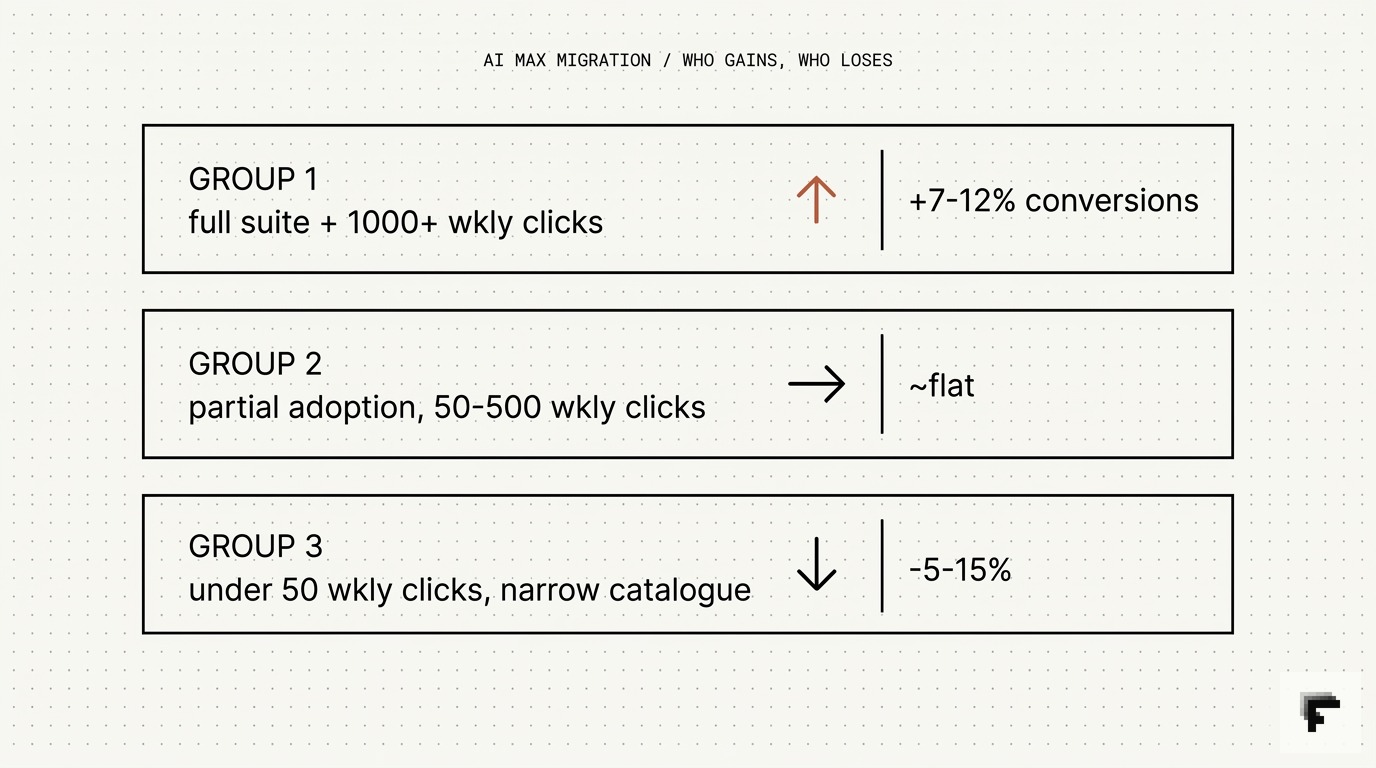
Group one: full feature suite, large account. Accounts running AI Max with broad match, final URL expansion, AI-generated text assets, and the AI Brief tool enabled across a search campaign with 1000+ weekly clicks see the 7-12% conversion lift consistently. The model has enough signal to choose between query interpretations, audience expansions, and creative variants in a way DSA's older heuristics could not. This is the cohort Google's announcement was describing.
Group two: partial adoption, mid-account. Accounts that enable AI Max but keep tight final URL controls, disable AI-generated assets, and run on smaller campaigns (50-500 weekly clicks) see roughly flat performance against DSA. The model gets the targeting freedom but is starved of creative variation, so the lift the full suite generates collapses. Most agency-managed accounts land here in month one because the partial-adoption setup is what survives change-control reviews.
Group three: small or niche accounts. Accounts under 50 weekly clicks, narrow product catalogues, or non-English-dominant markets see regressions of 5-15%. The model needs scale to learn from. Without it, AI Max behaves worse than DSA's deterministic rules, and the loss compounds quickly because there is no clean rollback once the upgrade has run for three to four weeks.
The migration checks that prevent regression
Three pieces of preparation separate the accounts that gain 7% from the accounts that lose 10%.
Tighten the negative keyword list before flipping the upgrade. AI Max's broader matching surfaces queries DSA would have ignored, and the negative list is the primary lever that keeps spend from chasing irrelevant terms. Accounts with strong negative lists see the 7% lift cleanly. Accounts with weak ones watch the spend redistribute toward queries that look thematically related but never convert.
Audit the final URL expansion permissions. AI Max can pull from any URL on the domain by default. For most accounts that is fine. For brokerages, e-commerce sites with seasonal landing pages, and any site with old archived content that should not receive traffic, restrict the URL expansion to the active page list inside the campaign settings. The default is generous to the point of negligence on long-tail content.
Set conversion goals before the upgrade, not after. AI Max optimises against the conversion goals configured at the campaign level. If those goals were left on auto-detection from the DSA era, the upgrade inherits whatever Google's auto-detection picked, which is rarely the goal that matters. Manual goal selection adds 10 minutes per campaign and prevents a quarter of optimisation drift.
What the announcement does not say
Two structural items missing from Google's marketing pitch matter more than the 7% lift number.
The upgrade is effectively one-way. Reverting from AI Max back to classic DSA is technically possible but rarely succeeds without performance loss, because the AI Max campaign accumulates learning data the older DSA campaign cannot inherit when you spin it up fresh. Treat the migration as a permanent commitment for that campaign.
AI Max competes for budget with Performance Max inside the same account. When both campaign types target overlapping queries (common on broad commercial intent), the AI Max campaign tends to absorb more budget at the expense of PMax conversions you may have been crediting elsewhere in your attribution model. Account-level audit before and 30 days after migration is the only way to see the redistribution clearly.
The migration is worth doing for most accounts that fit Group One. It is worth deferring for most accounts in Group Three. The middle group is a judgment call that depends more on how much creative iteration capacity the team has than on the algorithm itself. Server-side conversion tracking is the prerequisite either way, and the Meta CAPI work applies in mirror image on the Google side: cleaner conversion signal in, cleaner optimisation out.
Written by Foreground Digital. Start a project →