

Your Meta Pixel is losing half your conversions in 2026
Pixel-only Meta tracking misses more than half of actual conversions in 2026. The drift is structural, the math is brutal, and most advertisers have not yet adjusted their attribution to match what the platform is actually seeing.
Pixel-only Meta tracking misses more than half of actual conversions in 2026. The drift is structural, the math is brutal, and most advertisers have not yet adjusted their attribution to match what the platform is actually seeing.
The math is three losses stacked on each other.
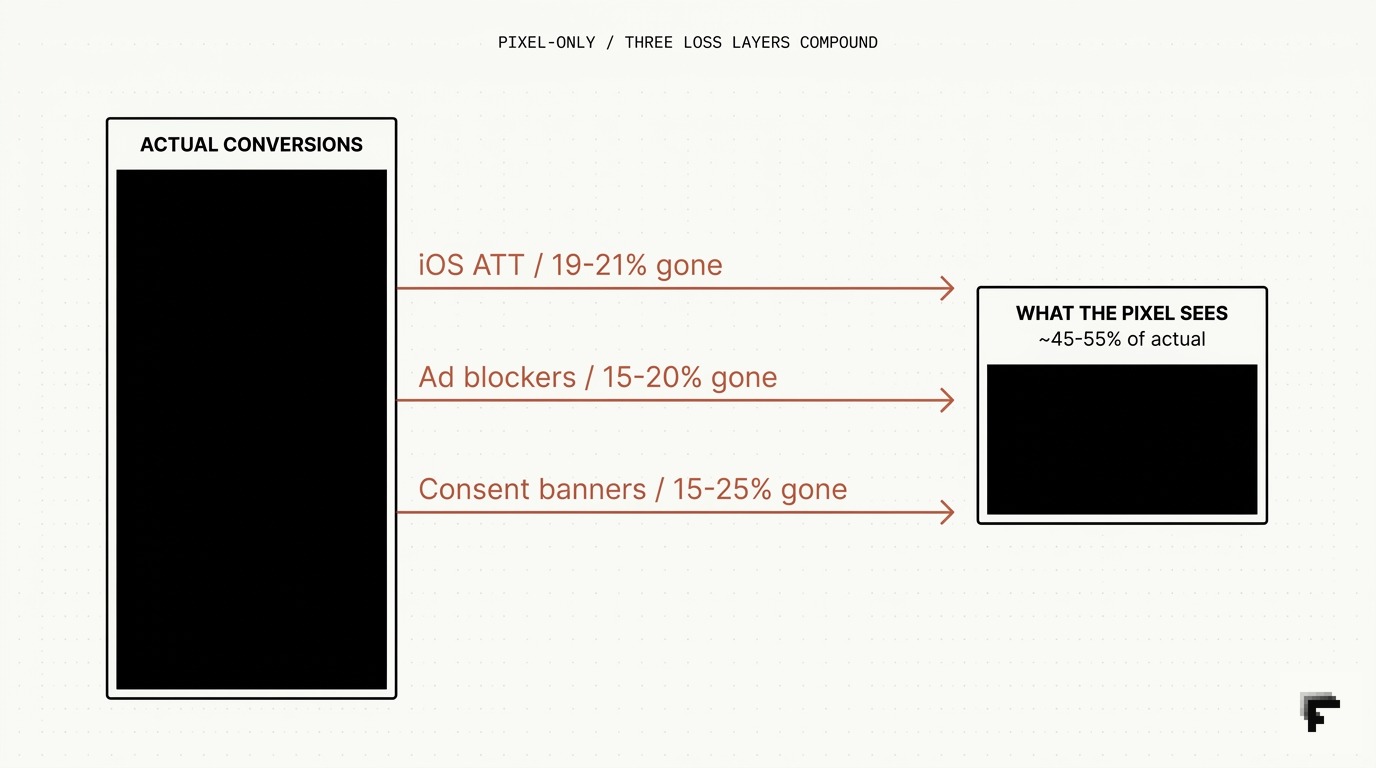
iOS App Tracking Transparency. Released April 2021, fully enforced by mid-2022. Opt-in rates settled around 30% across consumer apps and around 24% for adult mobile-web visitors (AppsFlyer 2025 ATT benchmark). When an iOS user declines, the Pixel cannot reliably fire on that user's conversion. iOS makes up roughly 28% of global mobile traffic and considerably more in the GCC. Apply the math: 28% × 70-76% opt-out = 19-21% of conversions invisible to the Pixel from iOS alone.
Ad blockers. Browser-level ad blockers (uBlock Origin, AdGuard, Brave shield) block the Meta Pixel by default. Penetration sits at 32-37% of desktop users in mature markets and around 22-25% on mobile. The blocked Pixel never fires. Another 15-20% of conversions across that traffic share become invisible.
Cookie consent banners. GDPR, PDPL, CCPA, and now Saudi PDPL enforcement require explicit opt-in for non-essential trackers. EU and GCC opt-in rates for marketing trackers sit around 40-55%. The Pixel fires only on opted-in sessions. A further 15-25% of conversions across that traffic share become invisible.
Stack the three. The exact loss depends on traffic mix, but most accounts are missing 45-60% of actual conversions through a Pixel-only setup. Meta's machine-learning optimisation, attribution model, and Advantage+ targeting all see only the conversions the Pixel reports. Half the buyer journey is invisible to the algorithm.
What the dual-tracking lift looks like
Meta's Conversions API is the server-side surface. Events fire from your server to Meta's servers, bypassing the browser entirely. iOS ATT does not apply because the call is not browser-based. Ad blockers cannot block a server-to-server call. Cookie consent still applies legally, but the API can fire on first-party consent that the browser-side Pixel could not capture.
Dual-tracking deployments (Pixel + CAPI together) report 8-19% more attributed conversions in published vendor benchmarks (Meta Conversions API performance studies, 2024-2025). The advertisers running it longest report higher lifts, closer to 22-28%, because Meta's algorithm has had more time to learn from the cleaner signal.
The 8-19% is the conservative number. The 45-60% is the actual gap. The difference between them is the conversions that were happening but the Pixel never saw, the algorithm never optimised toward, and the attribution model never credited to the right campaign.
What to do this week
Three moves cover most of the gap.
Run a Pixel and CAPI Auditor check against your live site. The 12-point audit catches the most common failures: events firing client-side only, deduplication ID mismatches, missing customer-data parameters, ATT-conformant event flagging, and the consent layer integration. Each one of these accounts for 5-15% of the gap.
Deploy CAPI on the conversions that decide buying intent: Purchase, Lead, InitiateCheckout, AddToCart. Skip the lower-funnel events (ViewContent, PageView) until the high-value ones are clean. Most installations get 80% of the lift from the four events above.
Wire deduplication via the event_id parameter so the same conversion fired by both the Pixel and CAPI is counted once. Without it, Meta deduplicates probabilistically, which works most of the time and fails for the conversions that matter most.
The Advantage+ vs Detailed Targeting decision is downstream of this work. Same with the 730-day retention extension. Neither helps if half the conversions never make it into the signal pipeline in the first place. Tracking is the load-bearing layer. Everything builds on it.
If the Pixel-only setup has been live for more than 18 months, the cost of the conversions Meta never saw is not recoverable, and most accounts in that bucket have been training their Advantage+ model on a 50%-corrupted view of who actually buys their product for so long that switching to CAPI mid-quarter produces a measurable behavior shift in the algorithm within fourteen days. The cost of the conversions Meta will not see next quarter, on the other hand, is.
Written by Foreground Digital. Start a project →