

Lindy, Agentforce, n8n: which agentic stack fits which business
Three different stacks have emerged for agentic AI in marketing operations. Lindy for the standalone agent builder, Agentforce for the Salesforce-native enterprise, n8n for the orchestration-first team. Each fits a different operating context.
Three different stacks have emerged for agentic AI in marketing operations through 2025-2026. Lindy. Salesforce Agentforce. n8n. They occupy adjacent territory but optimise around different assumptions about who is building the agents and what they are connecting to. Picking the wrong one for the wrong operating context costs more than the platform fee.
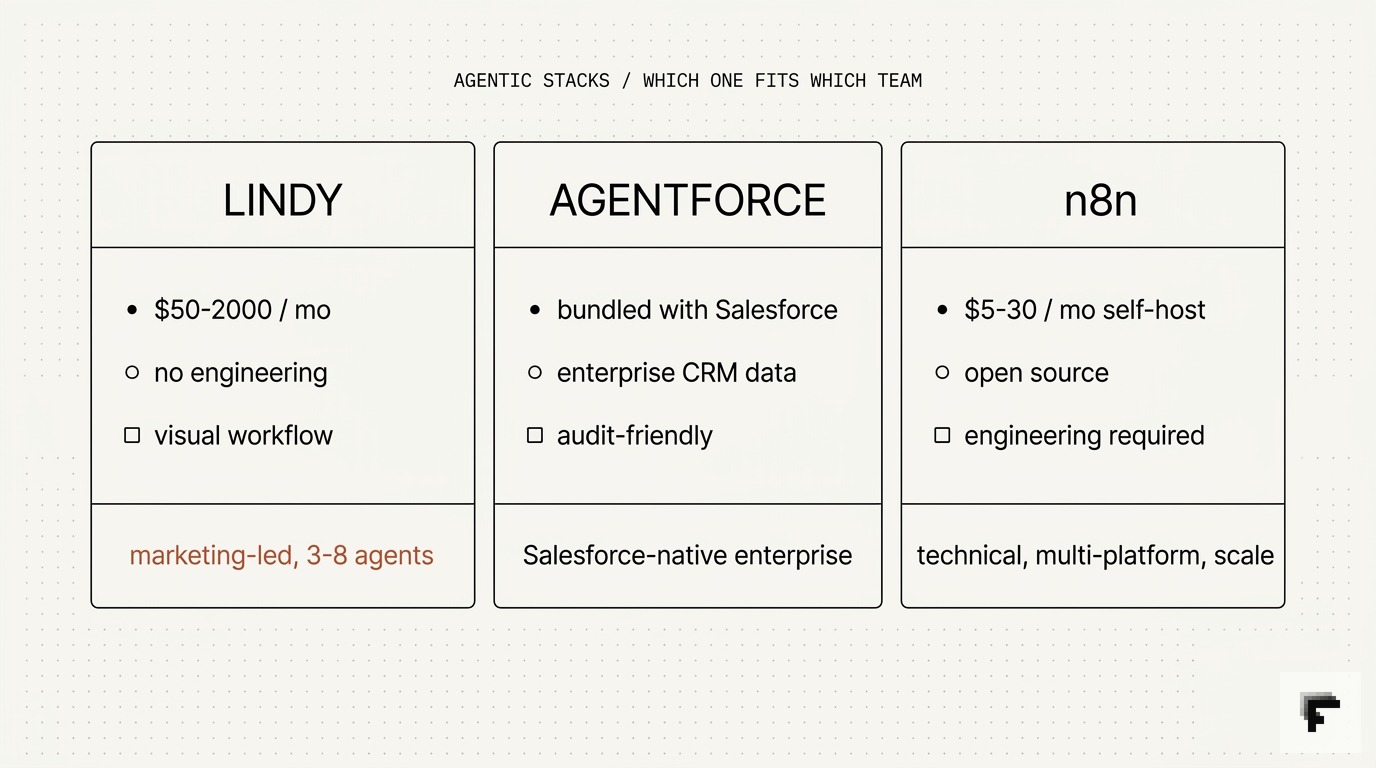
Lindy. Lindy is the standalone agent builder. Pricing starts around $50 per month for solo users and climbs into the $500-2000 per month range for team plans. The platform sits between the user and the underlying model providers (OpenAI, Anthropic, Google), abstracting prompt engineering and tool calls behind a visual workflow. Strengths: fast to ship a working agent, broad integration library, no engineering required. Limitations: the agent runs inside Lindy's environment, which means data-residency, custom routing, and complex multi-step orchestration are constrained by what the platform exposes. For solo founders, marketing managers, and small agencies running 3-8 standalone agents, Lindy is the right fit. For organisations with custom data systems or regulated workflows, the platform becomes the bottleneck around month four.
Salesforce Agentforce. Agentforce is the Salesforce-native agent layer launched in 2024 and matured through 2025. It runs inside the Salesforce platform, pulling from Marketing Cloud, Sales Cloud, Data Cloud, and Service Cloud as its action surface. Pricing is bundled into Salesforce contracts, which means it is effectively free for existing enterprise Salesforce customers and prohibitively expensive for everyone else. Strengths: native access to enterprise CRM data, audit trails that pass procurement reviews, integration with the surrounding Salesforce suite. Limitations: Agentforce is only valuable to the degree the surrounding Salesforce stack is. Companies running Salesforce as a thin CRM with most of the workflow logic elsewhere get little return from Agentforce. The classic "we have Salesforce but actually run on HubSpot for marketing" pattern is the wrong fit.
n8n. n8n is the orchestration-first stack. Open source, self-hostable, with a cloud-hosted tier starting around $20 per month and self-hosted deployments running on $5-30 per month VPS infrastructure. n8n sits between systems rather than acting as a self-contained agent platform. The orchestration layer fires LLM calls, integrates with arbitrary APIs, manages state across multi-step workflows, and produces auditable execution logs. Strengths: customisation depth, no platform lock-in, predictable cost at scale. Limitations: the engineering required to ship reliable agents on n8n is meaningful, and the team needs at least one engineer comfortable with workflow design, error handling, and state management. n8n is the right fit for technical teams building durable infrastructure. It is the wrong fit for marketing teams expecting a shipped agent inside the same afternoon.
The decision the platform comparisons miss
The honest decision rarely fits inside a feature comparison.
Lindy wins when the time to ship is the binding constraint. A marketing manager with zero engineering capacity and three agents to ship next week chooses Lindy without much consideration of the long-term tradeoffs. The platform earns its monthly fee through speed.
Agentforce wins when the agent must operate on real enterprise CRM data and produce outputs that survive audit. A bank, a regulated healthcare provider, or a multinational with strict data-governance requirements often has no other option that clears procurement. The platform earns its (substantial) bundled cost through compliance posture.
n8n wins when the workflow complexity exceeds what visual-builder platforms can express, or when the per-agent cost on Lindy / Agentforce becomes unsustainable at scale. A 20-agent deployment that costs $400 per month on n8n self-hosted would run $2000-4000 per month on Lindy at the same volume. The platform earns its (lower) ongoing cost through engineering investment upfront.
The wrong choice is picking the platform that fits the operating-context-you-want-to-have rather than the one you have today. Marketing teams without engineering capacity that pick n8n end up with agents that work in the demo and break in production. Engineering teams that pick Lindy end up rebuilding most of the workflow in code anyway because the visual builder cannot express what they need.
The right way to choose: pick the platform that fits the team you actually have, ship three real agents on it, then re-evaluate at month six against the operating reality rather than the procurement promise. The Meta CAPI work pattern applies here too. Clean signal in, clean output out. Most of the agentic ROI lives in the connections to existing data rather than the platform layer itself, because the model can only reason against what the surrounding workflow gives it, and a sophisticated agent running against a starved data pipeline outperforms a basic agent running against a clean one only in the demo. The platform is the easy decision. The data plumbing is where the real work sits.
Written by Foreground Digital. Start a project →