

Performance Max finally tells you where your budget goes
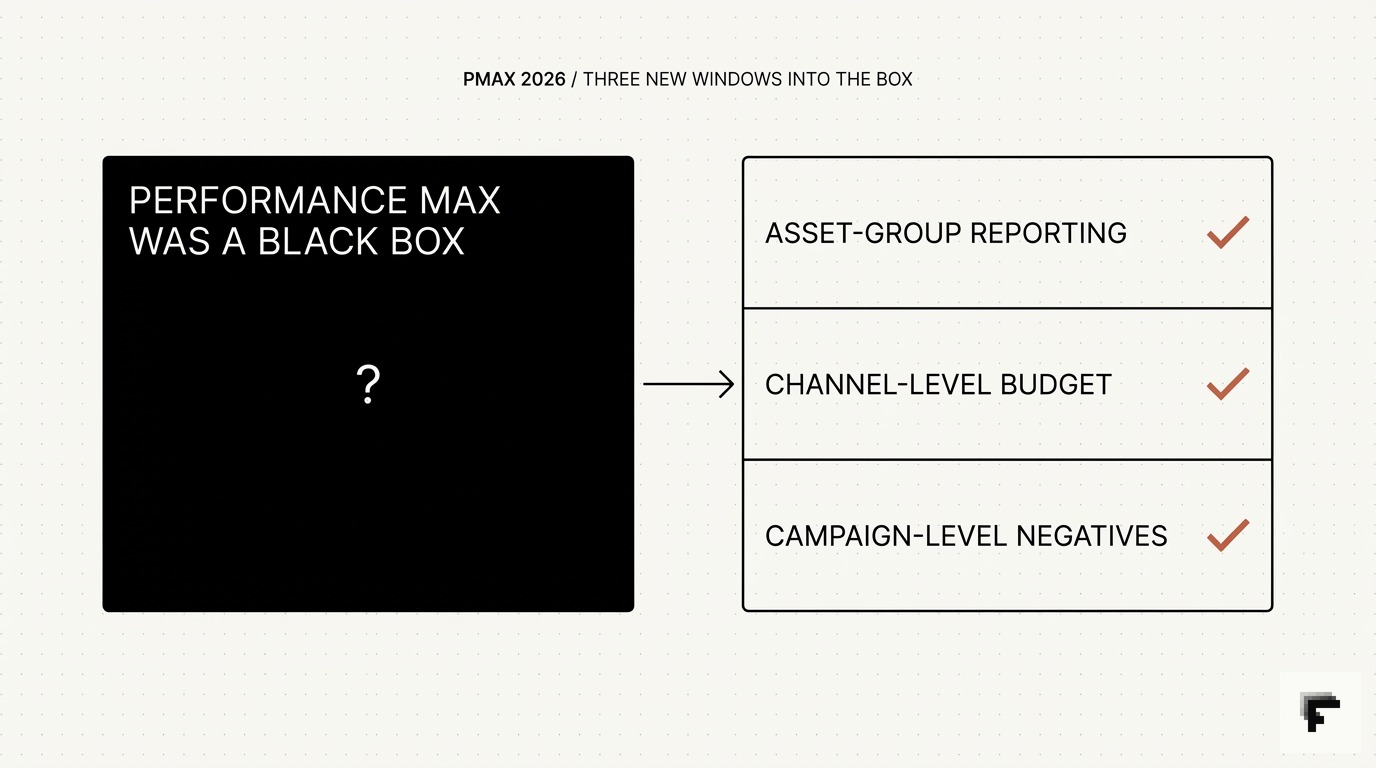
Performance Max was the black box of Google Ads for three years. The 2026 transparency updates open the panel for the first time. Asset-group reporting, channel-level budget visibility, and campaign-level negative keywords now ship in the standard interface.
Performance Max was the black box of Google Ads from 2022 through most of 2025. You fed it budget, creative, audience signals, and a conversion goal. You got back a single performance number and very limited visibility into how the conversion arrived. The 2026 transparency updates open the panel for the first time. Three things ship in the standard interface now. Asset-group level reporting, channel-level budget transparency, and campaign-level negative keywords. Each one closes a specific blind spot that cost most accounts real money.
Asset-group reporting. PMax campaigns can run multiple asset groups, each with its own creative variants and audience signals. Until 2026, performance was reported only at the campaign level. Which asset group was driving the conversions, which was burning budget without returning anything, was a guess most teams stopped trying to make. The new asset-group reporting surfaces conversions, conversion value, impressions, clicks, and cost at the asset-group tier inside the standard reports interface. Accounts running 3-5 asset groups inside a single PMax campaign can now see which group earns its budget and which one does not.
Channel-level budget transparency. PMax spreads spend across Search, Display, YouTube, Discover, Gmail, and Maps. The split was opaque for three years. As of Q1 2026, account-level reports show the budget distribution across channels, and the conversion attribution per channel. The most common pattern emerging from early disclosures is that 50-70% of PMax spend on most accounts went to Display and Discover (the cheap-impression surfaces), while 30-50% of conversions came from Search and YouTube (the more expensive ones). Accounts now have the data to argue with Google's allocation rather than accepting it.
Campaign-level negative keywords. PMax accepted account-level negative keyword lists from 2024. Campaign-level negatives shipped in 2026. The difference is that account-level negatives blocked terms across every campaign, which made the list inevitably conservative. Campaign-level negatives let a brand-bidding PMax campaign block irrelevant non-brand queries that another PMax campaign in the same account legitimately targets. The granularity opens up aggressive exclusion the older surface forbade.
What changes operationally
Three operational shifts compound across the updates.
Asset-group cleanup becomes a monthly review, not a quarterly mystery. With the new reporting, the underperforming asset group can be paused or rebuilt without guessing whether it was the asset group or the model. Most accounts find at least one asset group out of three to five that consistently underperforms once the reports surface it.
Channel exclusions move from blunt to surgical. PMax does not let you exclude channels outright, but the new visibility lets you optimise asset specifications (longer videos for YouTube, sharper image sizes for Display) by where the spend is actually going. The teams getting the most lift from the transparency are the ones rebuilding their asset library against the channel mix instead of treating PMax as a single buy.
Negative-keyword discipline becomes a campaign-level practice. The campaigns running brand defence, the ones running broad prospecting, and the ones running retargeting now each need their own negative list. The administrative burden is real, and an in-house team running 6-8 PMax campaigns adds roughly 2-3 hours per month to maintain the negatives across them. The payback shows up in spend that stops going to terms that never converted.
What the updates still hide
Two structural opacities remain.
Search-term reports inside PMax are still limited compared to the standard Search campaigns. Google releases a search-term insights tab, but the data is aggregated and trimmed for privacy. The 2026 update did not change this. Accounts running PMax for query coverage will not get the same granularity they had on Search-campaign reports.
The model's audience-signal weighting is still opaque. You can feed PMax audience signals (custom audiences, lookalikes, in-market lists) but Google does not disclose how heavily the model relies on each signal versus its own learned audiences. For most accounts this is acceptable. For accounts spending $100K+ per month on PMax, the lack of audience-weighting visibility is the next legitimate ask.
The transparency updates do not change PMax's fundamental nature. It is still a black-box optimisation engine, just one that now tells you the colour of the box. Accounts that treat the new reporting as a real source of optimisation decisions will outperform accounts that toggle the same campaign settings as before. The data is finally there. The decision to use it is still operational.
Server-side conversion tracking via the Meta CAPI work applies in mirror image on Google. Clean conversion signal into PMax produces clean optimisation against the new reporting; dirty signal produces noisy reports that look transparent but mislead the same way the old aggregates did.
Written by Foreground Digital. Start a project →