
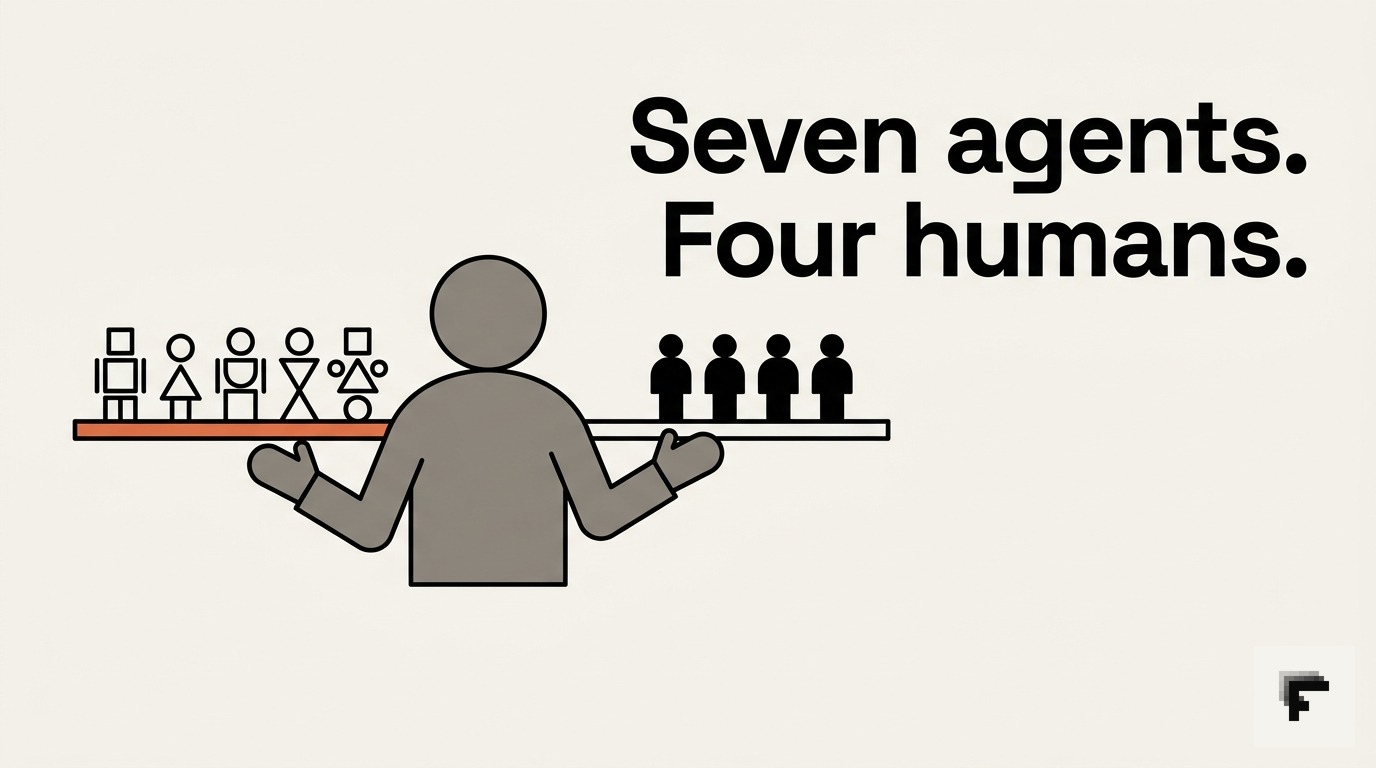
Replacing a marketing-ops team with seven AI agents: the realistic version
We replaced our entire marketing-ops team with AI" claims rarely survive scrutiny. The realistic version is more interesting and more useful. Here are the seven roles agentic AI can plausibly cover, and the four it cannot.
"We replaced our entire marketing-ops team with AI" is the headline most agentic-AI vendors are circulating in 2026. The claim almost never survives scrutiny. The realistic version is narrower, more interesting, and more useful for teams trying to make the transition without the LinkedIn-post mythology.
Across the industry, the operational ceiling on what marketing-ops agents can reliably do is roughly seven distinct roles. The boundary is empirical, not theoretical. The roles below ship reliably to production. The four roles after them break in ways that produce more cleanup than the agent saves.
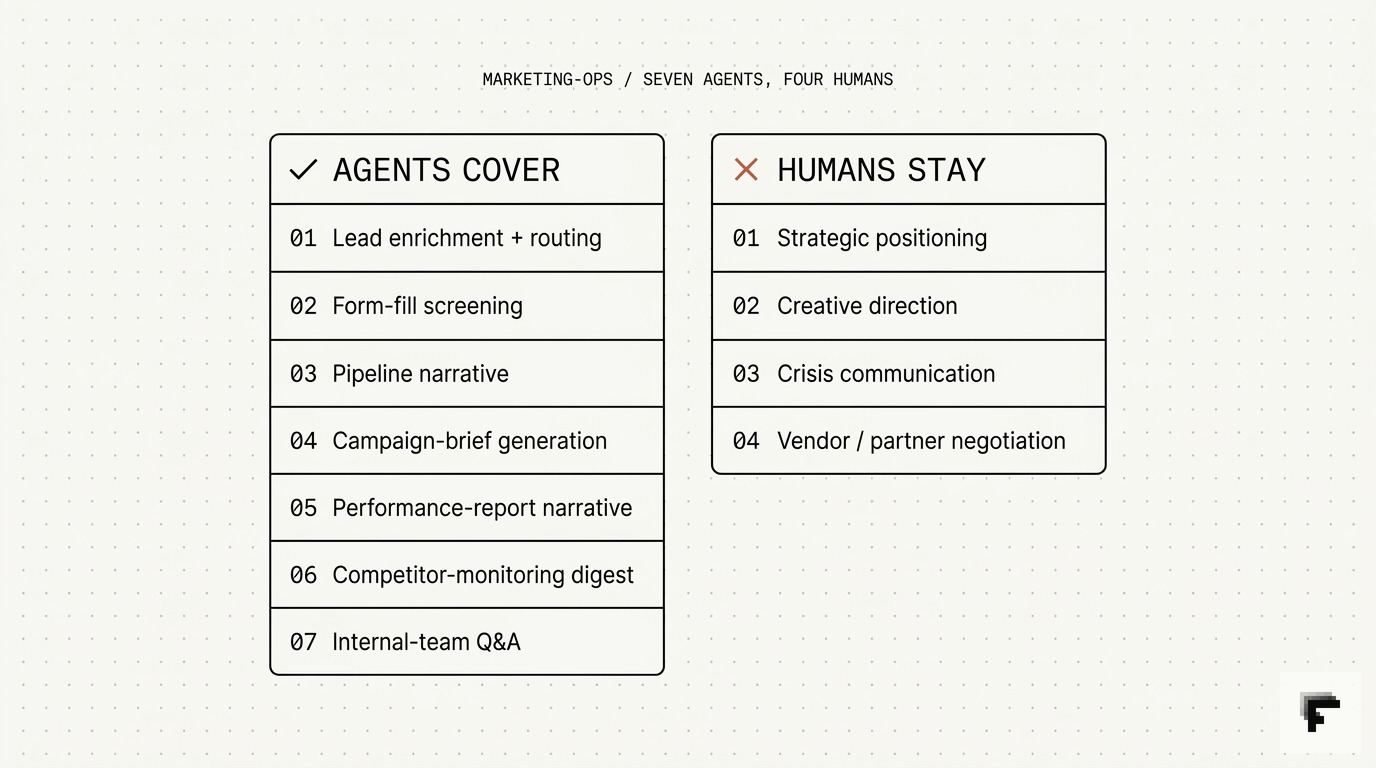
Lead enrichment and routing. Inbound MQL fires, an agent reads the contact data, enriches against public sources (LinkedIn, Crunchbase, the company website), scores against ICP criteria, and routes to the right sales rep or nurture sequence. The rules are crisp, the data is bounded, the failure modes are detectable. This is the highest-ROI agent in most marketing-ops stacks.
Form-fill quality screening. Most lead-gen forms accumulate garbage. An agent reads each submission, flags obvious fakes (disposable email domains, gibberish text, mismatched company-and-email pairs), and quarantines them before they hit the CRM. Saves 2-5 hours of weekly cleanup at the team level.
Pipeline-stage transition narrative. When an opportunity moves stage, an agent reads the meeting notes, the email history, and the deal record, then writes the narrative summary the next rep or manager needs. Replaces the "I'll write up the call notes later" debt that compounds inside most pipelines.
Campaign-brief generation. Given a target audience, a channel, and a conversion goal, an agent produces a structured campaign brief (objectives, segments, messaging angles, KPIs, creative requirements). The agent does not write the final creative. It writes the brief the human still uses to direct creative work.
Performance-report narrative. Numbers go into a dashboard. The agent reads the numbers, compares against the baseline, drafts the weekly narrative (what changed, why, what to do next). The senior marketer edits rather than writes from scratch.
Competitor-monitoring digest. An agent watches a defined competitor set across press releases, ad libraries, public job postings, and social channels, then ships a weekly digest highlighting changes worth a human read. Replaces the "oh, did you see [competitor] launched X" surprise.
Internal-team Q&A from the knowledge base. The 80% of internal questions that are answerable from the documentation get answered. The 20% that genuinely need a human get escalated. The ratio splits more cleanly than most people expect once the knowledge base has been audited.
Where the agent stops being the right tool
Four roles consistently fail in production.
Strategic positioning. Agents cannot pick the brand position the company should occupy in the market. They can generate options. The choice is human.
Creative direction. Agents can produce variations once the direction exists. They cannot make the original taste-driven call about what the brand should feel like.
Crisis communication. The first 90 minutes of a PR or customer-trust incident is human territory. The judgment about what to say, what not to say, who to escalate to, and how much to disclose is too consequential to delegate.
Vendor and partner negotiation. Procurement contracts, agency relationships, and platform-level escalations require sustained human relationship and read-the-room judgment. Agents that try this consistently produce embarrassing outputs.
The honest organisational picture
A two-person marketing team that adds the seven roles above through agents covers roughly what a five-to-six-person team did in 2022. The team does not get smaller. The team gets a different shape. The headcount that would have been in operational throughput moves into the four roles agents cannot do, which is where most of the strategic value lives anyway. The teams that get this right end up running leaner ops layers and richer strategy layers, with measurable improvement in the work the strategists actually have time to do.
The teams that get it wrong fire the ops layer, watch agents produce 80% of the throughput at 60% of the quality, and rebuild the ops layer twelve months later with a permanent productivity scar. The Lindy / Agentforce / n8n decision sits underneath this. The platform choice matters less than the role-by-role boundary discipline above it. Pick agents for the seven roles. Keep humans on the other four. Re-evaluate annually as the ceiling moves, because the boundary is empirical and the ceiling does shift, just slower than the marketing copy says it does.
Written by Foreground Digital. Start a project →