
Adobe Brand Visibility Solution: a peer review (2026)
Adobe rolled out a Brand Visibility Solution with LLM Optimizer and Brand Concierge in April 2026. The tooling is heavy, the price tag implied, and the gap for everyone outside the AEM stack is now obvious.
In April 2026, Adobe shipped its Brand Visibility Solution: a dashboard that shows where, how often, and in what context an organisation's name surfaces inside AI-generated responses (Adobe newsroom, 4 April 2026). It pairs with two other products announced at the same event. LLM Optimizer is a workflow for managing aligned content inside the surfaces large language models train on. Brand Concierge is an in-LLM experience layer, the early piece of an infrastructure the vendor wants to own end-to-end. Mention share, sentiment, citation source, co-citation with competitors, all surfaced inside a single tab in Experience Manager.
For enterprise marketing teams already running AEM, this is a serious piece of work. The Brand Presence dashboard is the first widely-available enterprise-grade view of "where am I in the AI answer?". LLM Optimizer does what most marketing teams have been doing manually for six months: identify under-cited topics, generate aligned content scaffolds, and push them through the AEM publication pipeline. Concierge is the more speculative play. The vendor wants the surface inside LLM responses, the kind of mini-app that runs when ChatGPT mentions your name, and Concierge is the early foothold for that future.
Real engineering. Heavy pricing.
Where Adobe Brand Visibility Solution falls short for non-enterprise brands
The vendor has not published a public price for the Brand Visibility Solution. Adobe Experience Cloud deployments are quoted, never listed. Industry agency benchmarks place the AEM-integrated tier in the mid-five to low-six-figure annual range for mid-market accounts. Full-suite enterprise deployments climb into seven figures. The integration assumption is the harder gate. You need a content team operating inside AEM, a structured-data layer already populated with the Organization schema, and the editorial muscle to push the LLM Optimizer's recommendations through a publication workflow on a continuous cadence. For a Dubai brokerage with three marketing hires and a WordPress install, this is the wrong tool. It is built for teams already running Analytics, Workfront, Real-Time CDP, and Target. The new dashboard sits inside the same fence.
Call this the AEM ceiling. The same diagnostic they are selling at six figures is structurally available outside the stack, just unbundled.
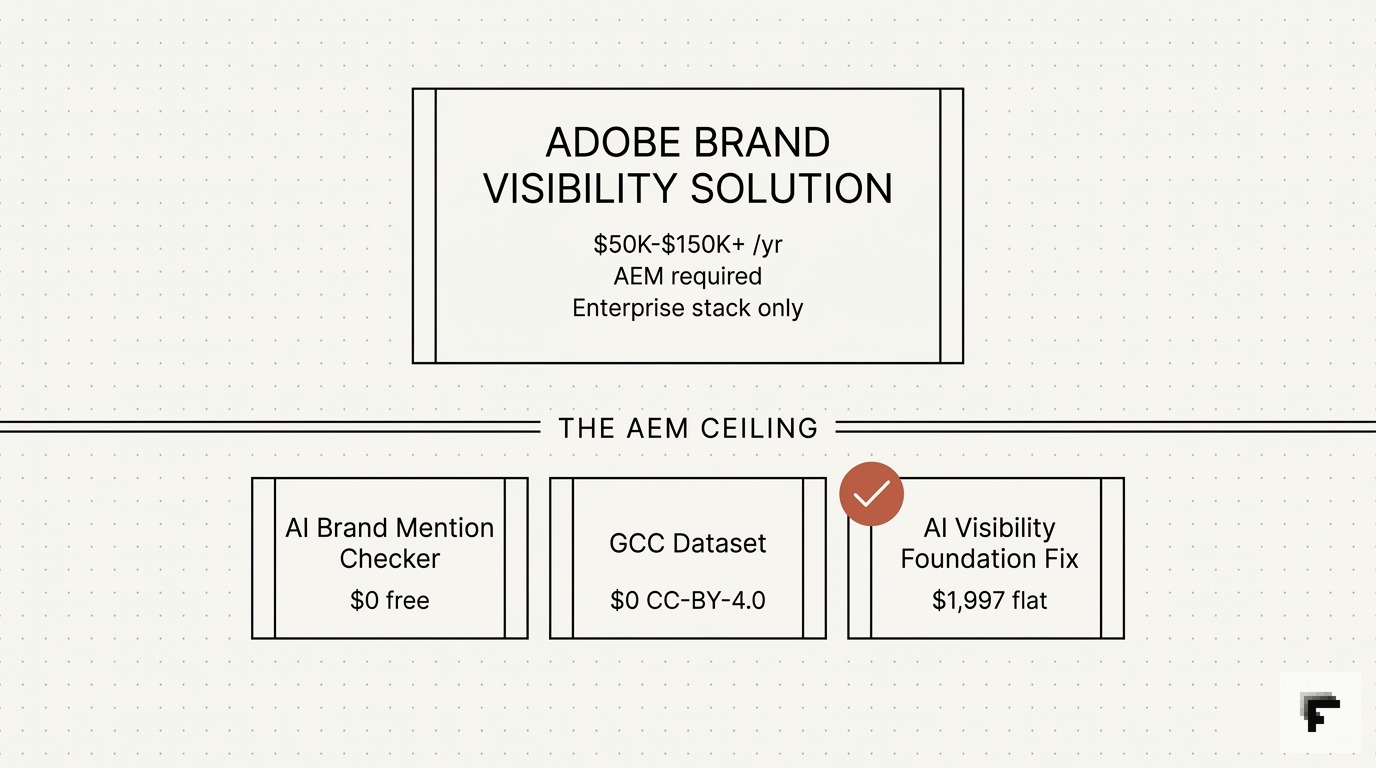
The free AI Brand Mention Checker Foreground publishes runs the same five-engine query the Brand Presence dashboard runs (Claude, ChatGPT, Gemini, DeepSeek, Perplexity), with the same per-engine score, sentiment, and competitor co-citation surfaced inside a one-minute browser session. No AEM, no licence, no signup beyond email. The weekly GCC AI brand visibility dataset does the same thing across 50 brands per industry, published under CC-BY-4.0. The repair side, the LLM Optimizer equivalent, is what the AI Visibility Foundation Fix delivers at $1,997 flat: entity graph, Wikidata QID, schema across top pages, AI crawler access, brand-disambiguation content, and a day-14 re-baseline. Same diagnostic outputs, same repair playbook, three orders of magnitude cheaper.
The product is not bad. It is genuinely the most polished enterprise view of AI brand visibility on the market right now. The catch is that the underlying mechanics are publicly documented: entity grounding, schema, third-party citation density, and retrieval rather than ranking. The dashboard wraps work any team with senior engineering can do in-house. What they sell is convenience, integration, and the meeting-room comfort of a CMO-grade tab inside Experience Manager. For everyone else, the visibility stack is buildable without the licence.
If you have AEM and a content team to feed it, Brand Visibility Solution is probably worth the line item. If you do not, the underlying recommendation gap is still there, the diagnostic is free, and the fix is in the public domain.
Written by Foreground Digital. Start a project →