
ChatGPT vs Perplexity: why GEO is two strategies, not one
ChatGPT and Perplexity cite almost completely different sets of domains. Treating GEO as one strategy hides the gap at the exact layer where the optimisation work splits.
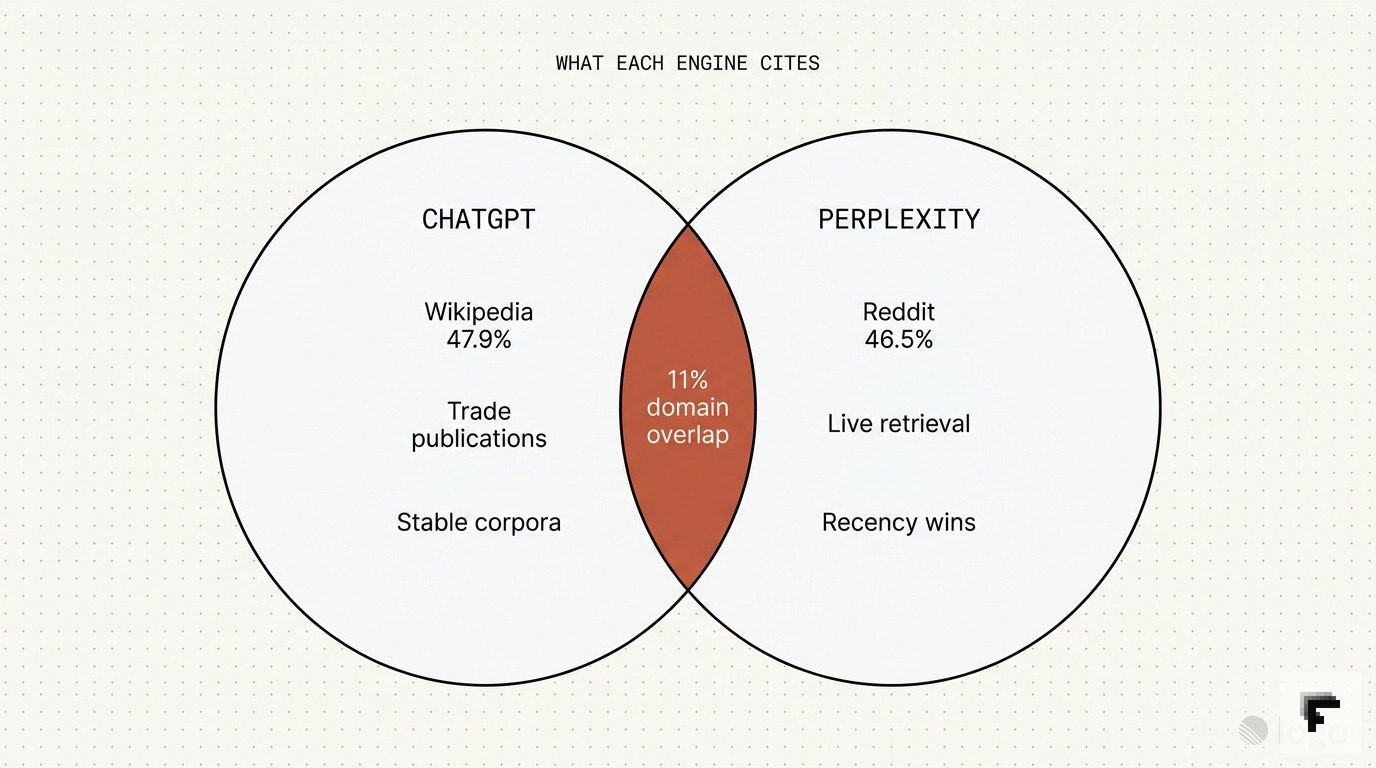
The most useful number in generative engine optimisation is 11. That is the percentage of domain overlap between the sources ChatGPT cites and the sources Perplexity cites in their respective answers (Enrich Labs GEO study, 2026). Ranking on one engine guarantees almost nothing on the other. They are different problems.
ChatGPT pulls heavily from a small set of authoritative aggregators. Wikipedia accounts for roughly 47.9% of its top citations (Frase aggregated data, 2025). The remaining citations cluster around long-established editorial publications, government domains, and category incumbents the training corpus weighted heavily during ingestion. Recency carries less weight. Brand-name density across stable, trusted sources carries more. A small Dubai brokerage that publishes a fresh guide weekly will struggle to surface on ChatGPT unless that guide is also being quoted on Wikipedia, Crunchbase, or a recognised industry publication.
Slow signals win there.
Perplexity works almost in opposition. It pulls live results in real time. Reddit accounts for around 46.5% of Perplexity citations on certain query types (ZipTie analysis, January 2026). Forum threads, Stack Overflow answers, and live customer review platforms feed it as heavily as established editorial sources. Freshness wins. A timestamped, well-structured page published this month can compete with a Wikipedia article that has been stable for a decade.
The gap is structural, not stylistic. ChatGPT optimises against pattern density inside a corpus that updates slowly. Perplexity optimises against citation freshness inside a live retrieval index. Two scoring functions. One question. The GEO playbook for each is shaped by what gets rewarded in that specific layer, which means the work splits at the foundation and stays split.
Two playbooks, one foundation
The foundation is shared. Both engines need a clear entity grounding (schema, Wikidata QID, sameAs network), authoritative third-party mentions, and content structured for retrieval. The visibility stack post breaks down what that foundation looks like, and the AI Visibility Foundation Fix productises the 10-deliverable version of the work.
Above the foundation, the two playbooks diverge.
For ChatGPT, the work is slower and more PR-shaped. Get cited on Wikipedia where notability is genuinely there (a Wikidata QID does not automatically grant Wikipedia eligibility, but it is the precondition). Land placements in trade publications the training corpus has ingested. Build sameAs entries on Crunchbase, LinkedIn, GitHub where applicable, and ORCID for any named experts. Author-byline content on industry sites that have been around long enough to be weighted in the training data. None of this surfaces in a 30-day window. Most compounds over two to three training-data cycles, which is roughly six to nine months from start to visible movement.
For Perplexity, the work is faster and more publication-cadence-shaped. Publish dated content with explicit timestamps. Seed evergreen presence on Reddit, Stack Overflow, and category-specific forums where appropriate, without spamming. Get listed on review aggregators (G2, Capterra, Trustpilot) with structured review schema. Maintain content velocity. Perplexity rewards sites that show up consistently inside the live index, which means six new pages per month tends to outperform six pages per quarter regardless of which is longer-form.
The mistake most teams make is picking one playbook and running it against both engines. Wikipedia-heavy work shows up nowhere on Perplexity for six months. Reddit-heavy work barely registers on ChatGPT. Both layers need to run in parallel, with different teams, different cadences, and different success metrics.
The AI Brand Mention Checker Foreground publishes reports per-engine scores explicitly. ChatGPT presence, Perplexity presence, Gemini presence, and Claude presence are returned as four independent numbers, not averaged into a single GEO score. The averaging is the most common mistake in industry reports. The open GCC dataset makes the same split visible across 50 brands per industry, so you can see how wide the per-engine spread runs in practice.
If you are scoring above 60 on ChatGPT and below 20 on Perplexity, you have a velocity problem. If you are scoring above 60 on Perplexity and below 20 on ChatGPT, you have an authority problem. The recommendation gap sits in different places for different engines, and the fix sequence depends on which one is broken.
Written by Foreground Digital. Start a project →