
Headless WordPress for Dubai agencies: when it earns the cost
Headless WordPress was the architectural badge of honour for Dubai agencies through 2024. Most of those builds did not earn back their cost. Here is the honest decision tree for when to go headless and when to stay classic.
Headless WordPress was the architectural badge of honour for Dubai agencies through 2024. Decoupled front-end, REST or GraphQL API, the CMS pushed into a back-room role while a Next.js or Astro layer rendered the user experience. The pitch was performance, security, and developer-experience. The reality on most of those builds was a 3-5x cost premium versus a standard WordPress install, with the operational complexity that follows the same multiplier.
Some of those builds earned the cost. Most did not.
The honest decision tree fits four conditions. Hit all four, the headless build pays back inside 18 months. Hit three or fewer, the classic install almost always wins on total cost of ownership.
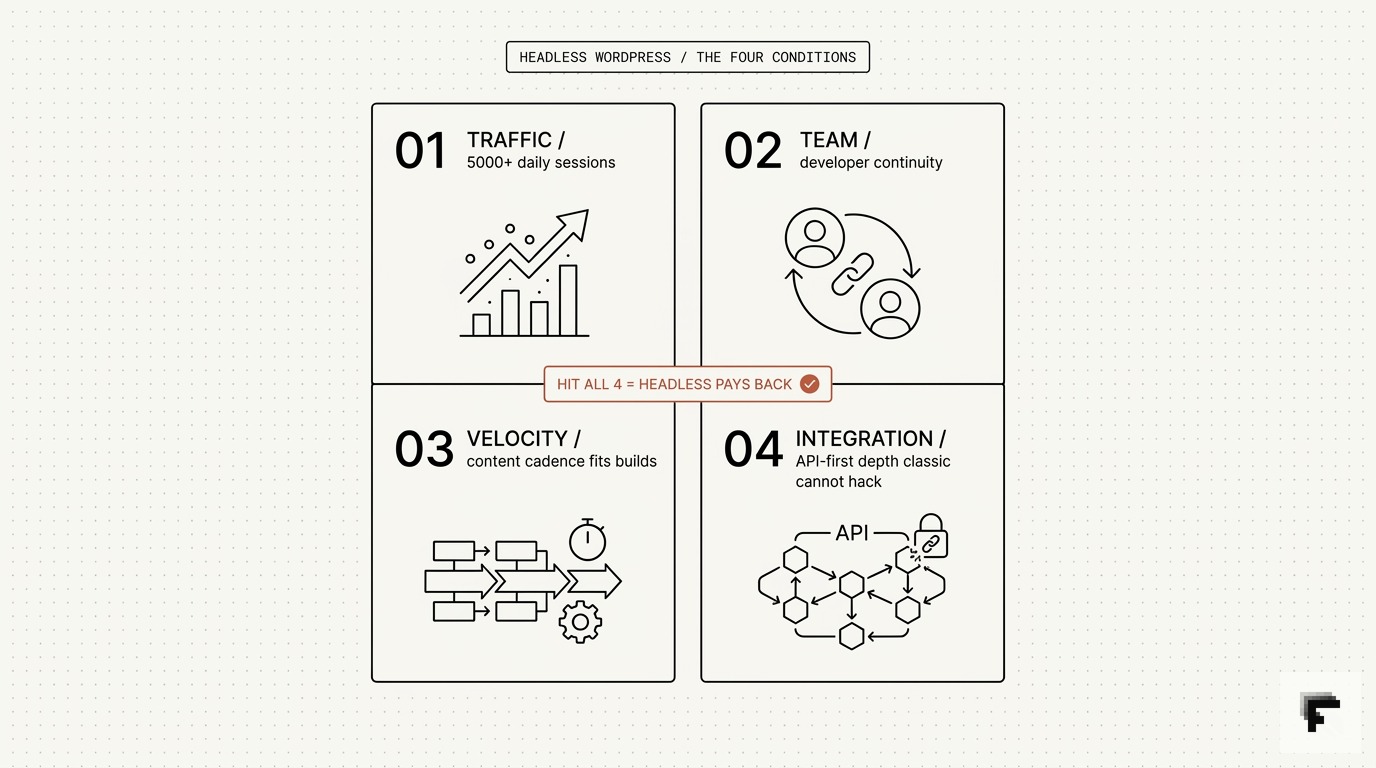
Condition one: traffic that justifies the speed gap. Headless wins on Core Web Vitals against classic WordPress on heavy traffic sites. At 5,000+ daily sessions, the LCP and INP advantage compounds into measurable conversion lift. Below 1,000 daily sessions, the speed gap matters in theory and not in practice; classic WordPress with a competent host (Kinsta, WPEngine, or a tuned Cloudways install) performs well enough.
Condition two: developer team continuity. Headless requires Node, React or another modern framework, build pipelines, deployment workflows, and ongoing dependency management. The team has to maintain it. Dubai agencies that outsource the build and then move the site to an in-house team of WordPress generalists end up with a system nobody owns. The classic install survives operator changes. Headless does not.
Condition three: content velocity that fits the constraint. Classic WordPress lets a content editor publish in three clicks. Headless usually requires a build step (or at least a webhook-triggered redeploy) before changes go live. Sites publishing four to ten pieces per week handle this fine. Sites publishing fifty pieces per week, with last-minute edits and translations, will be fighting the build pipeline constantly. The constraint is more operational than technical.
Condition four: integration depth that classic cannot handle. Some product use cases (real-time pricing displays, dynamic inventory feeds, multi-source content composition) need an API-first architecture that classic WordPress can be hacked into producing but never elegantly. If the product genuinely lives on this kind of integration, headless wins on capability, not on speed.
When classic WordPress still wins
Eight conditions consistently favour the classic install for Dubai agencies and the businesses they build for.
The build budget is under $30K. Headless construction starts around $40-60K for a competent team. Below the budget floor, the build will be either incomplete or will cut corners that show up in production.
The team maintaining the site has WordPress skills but not modern JS-framework skills. Hiring for the latter in Dubai costs roughly 1.5-2x the former, and the talent pool is shallower.
The site publishes informational content and earns most of its traffic through SEO and AI search citation. The schema-based citation work and AI brand visibility moves are equally available on classic WordPress and headless. The architectural choice changes very little on the citation surface.
The site is a brochure plus a contact form. Headless is overkill. A classic install with a tuned host and a clean theme outperforms a half-finished headless build on every metric that matters.
The site is a brokerage listing site under 5,000 properties. WordPress with a good real-estate plugin (or a custom post type) plus a fast host handles this volume without breathing hard. Headless adds operational cost the listings traffic does not justify.
The site needs to be transferred to a different agency or in-house team in the next 24 months. Headless transfers are surgically painful. Classic transfers are routine.
The team needs to ship content edits during business hours without involving a developer. Classic WordPress assumes this is the default. Headless assumes it is not.
The compliance footprint requires GCC PDPL, UAE Data Office reviews, or Saudi PDPL audits. The classic stack has more documented compliance patterns; headless setups require custom audit-trail work that adds another 15-25% to the build cost.
The middle ground most agencies miss
A growing pattern that often beats both ends of the spectrum: classic WordPress with aggressive performance tuning, an edge-CDN front-end (Cloudflare or BunnyCDN), and selective static site generation for the highest-traffic pages. The result is most of the headless performance benefit at a fraction of the operational cost.
Self-host the install. Use a tuned theme with no bloat plugins. Defer JS aggressively (covered in the LCP 2.0s threshold piece). Edge-cache the listing pages. Run a clean Core Web Vitals audit and fix the actual bottlenecks rather than swapping the entire architecture.
For Dubai agencies pitching builds in 2026, the honest conversation with the client is rarely "headless or classic". It is "what does the site actually need to do, who maintains it, what does it cost to keep running for three years". The architecture follows from the answer. Headless is a tool; the agencies that treat it as a default sell builds that fail their clients eighteen months later when the maintenance bill arrives.
Written by Foreground Digital. Start a project →