
Schema for AI search citations: what actually gets quoted
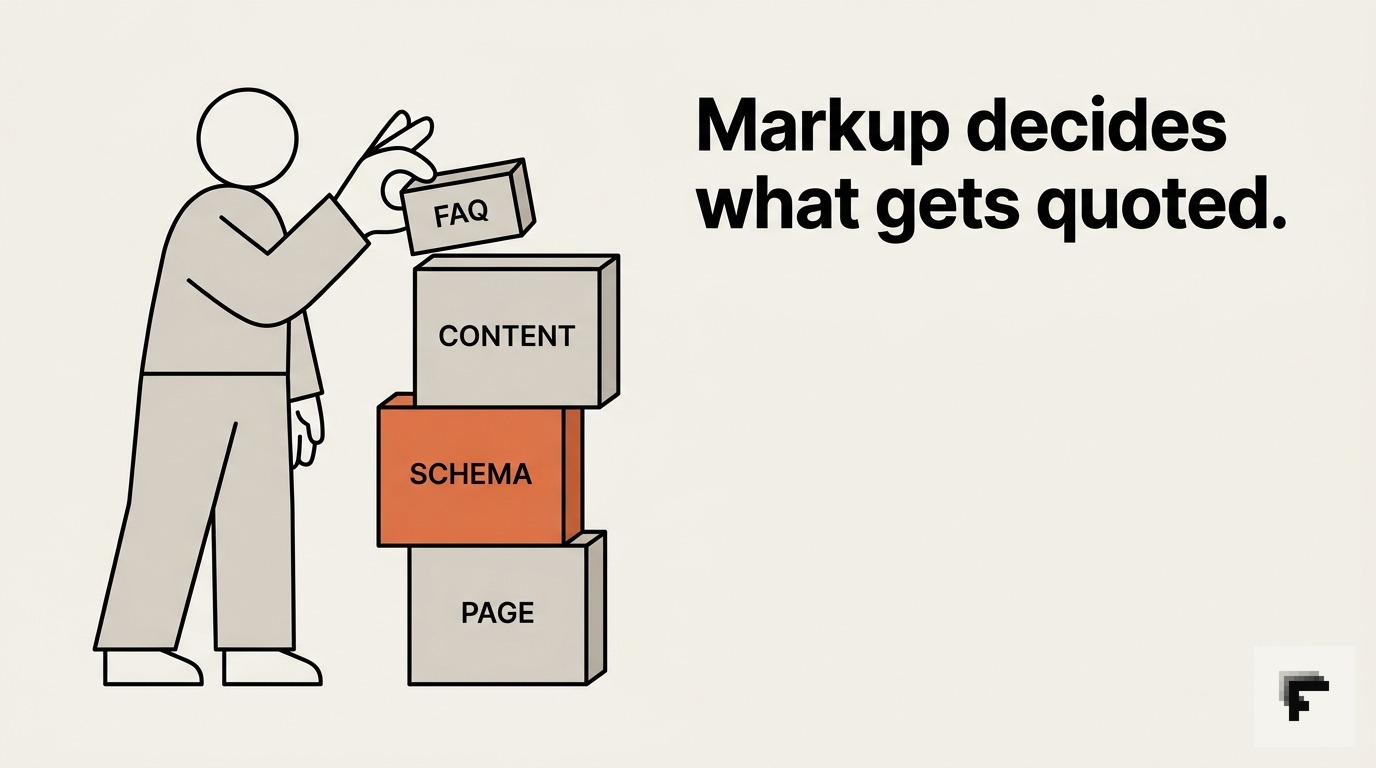
Schema markup is no longer just an SEO signal. It is the parser layer AI engines use to decide whether your page can be quoted. The required types are narrower than the full Schema.org spec, and FAQ pulls more weight than most teams give it credit for.
Schema used to be an SEO nicety. Now it is the parser layer that decides whether ChatGPT, Google's AI Overview, Perplexity, or Gemini can quote your page at all. The shift happened quietly. Between mid-2025 and early 2026 the structural rule baked in: retrieval-first AI engines need entity-level signals they can read deterministically, and structured data is the cleanest way to hand them one.
The required markup for AI citation work is narrower than the full Schema.org catalogue. Four types do most of the lifting.
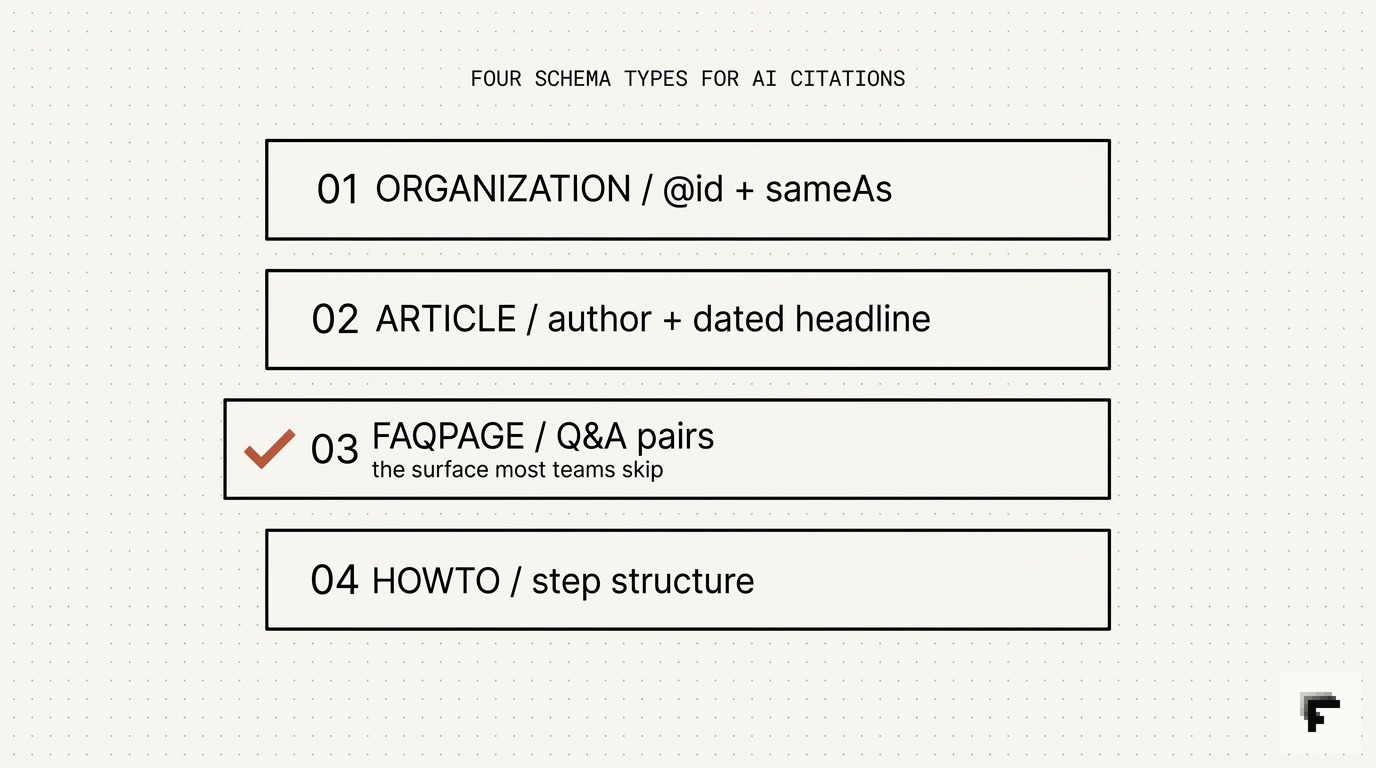
Organization. A stable @id and a complete sameAs network are the entity foundation. Without them, the model has no way to know that "Foreground", "Foreground Digital", and "foreground.agency" refer to the same brand. This is the single most common gap in AI brand audits, and the visibility stack post breaks down why the entity layer compounds slower than the content layer.
Article. Author markup with a dated headline is the byline signal. Bylines tied to verifiable identities (LinkedIn, ORCID, Crunchbase) feed both the E-E-A-T cluster Google uses and the entity-credibility signal AI engines apply to citation eligibility. Sites that quietly removed bylines to save on author bios paid a real price in the March 2026 core update.
FAQPage. The most overlooked citation surface in 2026. Google killed the FAQ rich result in 2023. Most teams abandoned the markup entirely after that. The retrieval layer kept reading it. AI engines retrieve, they do not rank, which means a clean Q-and-A pair structured as FAQPage JSON-LD is one of the highest-yield citation pulls available right now. The Search Console data backs it up. "FAQ schema improve citations AI search results" sits at position 20 on Foreground's own search analytics as a live and growing query.
HowTo. The procedural citation surface. AI Overviews on "how to do X" queries pull from HowTo-marked content disproportionately. The structured step list gives the retrieval layer an unambiguous quote target without inference.
Deploying structured data for retrieval, not just for rankings
The deployment moves diverge from classic SEO advice in three places.
First, validate against the actual retrieval requirements, not the Google Rich Results test. Rich Results validates rendering eligibility for SERP features that may or may not still exist. AI engines need parseable JSON-LD that resolves cleanly to an entity URI. Bing Webmaster Markup Validator catches errors the Google test misses. Schema.org's own validator is the closest thing to a ground-truth check.
Second, deploy the Organization type once and propagate the @id across every page. The stable URI is what links your home page, blog posts, About page, and tool pages into one entity the model can recognise. Without the stable @id, every page reads as a separate entity to the retrieval layer, and citation share fragments across them rather than compounding to your brand.
Third, pair the markup with llms.txt and the markdown twins at the route level. The llms.txt spec gives crawlers a curated map of your highest-value pages. The .md twins provide clean markdown that the retrieval layer can pull without re-parsing your full HTML. Together they reduce friction between your content and the citation engine.
Markup alone does not fix invisibility. Sites with zero authority cited in zero places will not get quoted just because their JSON-LD is clean. But the recommendation gap for sites that already have category authority and editorial visibility almost always has a structured-data fix as part of the diagnosis. The AI Visibility Foundation Fix deploys all four types across the top 10-25 pages as part of the 14-day scope, but the work is documented enough that a senior engineer can ship it in-house with two or three days of focus.
If you have to pick one type to deploy this week, deploy Organization with a stable @id and a complete sameAs network. Without that one, none of the others compound to your brand. Once Organization is locked, FAQ and Article on your top-traffic pages are the next two moves, in that order.
Written by Foreground Digital. Start a project →