
Stape vs native CAPI vs custom server: which wins in 2026
Three ways to ship Meta server-side tracking in 2026. Stape rents you the GTM server, Meta's native Gateway pre-wires it, custom hosting gives you full control. Each one fits a different operational reality.
Server-side tracking via Meta's Conversions API stopped being optional in 2026. The next decision is how to host the server. Three paths dominate. Stape (the managed GTM Server-Side host). Meta's native Conversions API Gateway. Or a custom server, usually on a VPS or container platform you control. Each one fits a different operational reality, and the wrong choice for the wrong context costs more than the right choice anywhere.
Stape. Stape rents you a Google Tag Manager Server-Side instance with the Meta CAPI tag pre-installed, plus the consent-mode handling and event-deduplication logic most teams would otherwise have to wire themselves. Pricing starts around $20 per month for low-volume sites and climbs into the $200-500 per month range for the higher-traffic tiers. The platform sits between you and Meta, which is the value (no infrastructure to maintain) and the limitation (you do not see the raw HTTP traffic). For a Dubai brokerage with three marketing hires and a WordPress install, Stape is almost always the right starting point. For an enterprise with sensitive PII or regulatory constraints, the data-residency questions get harder.
Meta's native CAPI Gateway. Meta shipped its own Gateway in 2023 and tightened it through 2024-2025. It runs on AWS infrastructure provisioned through CloudFormation, costs roughly $50-150 per month in AWS resource billing (no Meta-side fee), and is the cleanest path for an in-house team that already operates on AWS. The Gateway handles consent mode, dedup, and event enrichment natively. The catch is that the Gateway is single-tenant per Pixel ID, so multi-brand portfolios end up provisioning one Gateway per brand, with the operational overhead of each compounding. For a single-brand business with an in-house AWS team, the native Gateway is often the best technical fit. For agencies running 10+ client Pixels, the per-brand AWS provisioning gets old fast.
Custom server. A custom server (Node, Go, or PHP, hosted on Hetzner, Fly.io, Railway, or DigitalOcean) costs $5-30 per month in hosting and gives you complete visibility into the event flow. The value is configuration granularity that Stape and the native Gateway both hide: custom event deduplication logic, custom enrichment, custom routing across multiple ad platforms simultaneously (Meta + LinkedIn + TikTok + X CAPI through one ingestion pipeline). The cost is engineering time. A clean custom CAPI setup needs roughly 3-5 days of senior engineering to ship, plus ongoing maintenance for SDK updates, schema changes, and Meta's event-coverage requirements. Build it for the long-haul case, not as a starter project.
Decision matrix
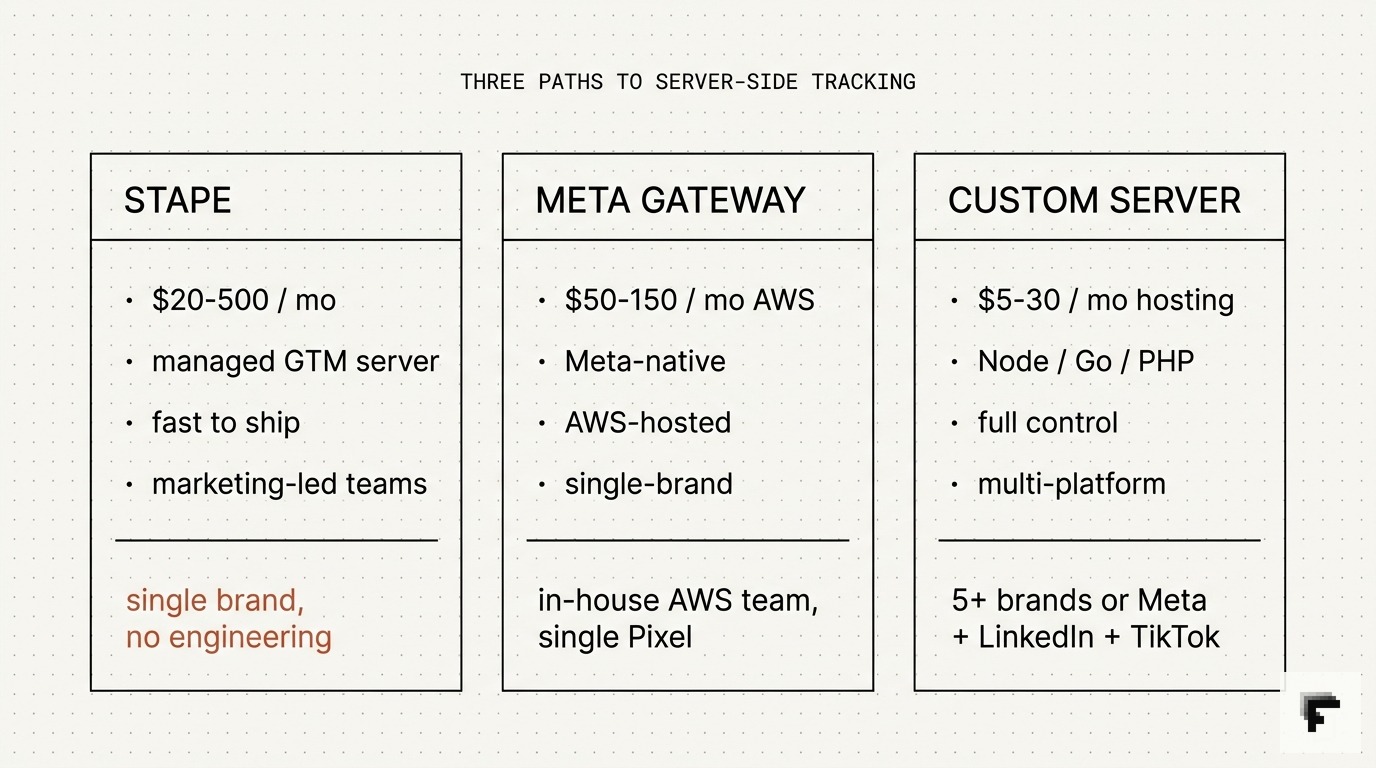
The honest decision tree fits on one screen.
Single brand, marketing-led team, WordPress or Shopify, under $50K monthly ad spend: Stape. The managed cost is dwarfed by the time you do not spend maintaining infrastructure.
Single brand, in-house engineering capacity, already on AWS, single-Pixel deployment: Meta's native Gateway. The AWS bill is lower than Stape, the integration is cleaner, and the support path goes directly to Meta when something breaks.
Multi-brand agency, multi-Pixel deployments, multi-platform CAPI (Meta + LinkedIn + TikTok): custom server. The per-brand cost of Stape compounds beyond five brands, the per-brand cost of the native Gateway compounds even faster, and the custom server is the only path that consolidates all platforms into one ingestion layer.
Enterprise with regulatory or data-residency constraints (GCC PDPL, EU GDPR with strict data processor requirements): custom server, usually on regional infrastructure (Hetzner Frankfurt for EU, AWS me-central-1 for UAE), with a DPA signed by your hosting provider rather than a US-based managed service. The compliance team will care more than the marketing team about this distinction.
What the comparison rarely says out loud
Three operational realities matter more than the platform choice for most accounts.
The deduplication ID has to fire consistently from both the browser-side Pixel and the server-side CAPI surface. Without it, Meta deduplicates probabilistically, which fails on exactly the conversions that matter most (high-value, low-volume events). The Pixel and CAPI Auditor checks cover this directly; the audit takes about ten minutes.
The customer-data parameters (em, ph, fn, ln, country, zp) need to be hashed and passed in for the event-match-quality score to climb above 7.0 out of 10. Most Pixel-only setups score 4-6. Properly-configured CAPI setups score 8-10. The score is not cosmetic; it directly affects Advantage+ targeting accuracy and the 730-day retention audience quality.
The events fired through the server-side path have to match the events configured in the Meta Pixel inside Events Manager. Mismatched naming (Purchase vs purchase, Lead vs Form_Submit) is the second most common cause of CAPI installations that "work" but never lift attribution numbers. The fix is a 15-minute audit. The cost of not running it is months of optimised spend against the wrong signal, and the longer that runs, the more the algorithm calibrates against a corrupted view of who actually converts.
Most teams overweight the platform decision and underweight the configuration decision. The platform you pick decides who maintains the server. The configuration decides whether the server produces useful data. The second one is where almost all the conversions Meta misses actually live.
Written by Foreground Digital. Start a project →