

Five GEO tracking tools reviewed: what each one misses
A new category of GEO tracking tools has emerged in the last twelve months. Most of them solve the easy half of the visibility problem and skip the half that actually decides whether brands get cited.
A year ago, "AI brand visibility tracking" was not a software category. By late 2025 it was, and by mid-2026 there are at least a dozen tools competing for the same enterprise marketing budget. The category is moving fast. The actual diagnostic, less so.
Across the five most-circulated platforms (Profound, Otterly, Peec AI, BrandRank, Trysight), the feature lists converge on the same five things. Per-engine visibility scoring across ChatGPT, Gemini, Perplexity, and Claude. Sentiment of each mention. Co-citation with competitors. Historical tracking over time. Suggested prompt sets the user can run.
Convergence is not the problem. The shared blind spots are.
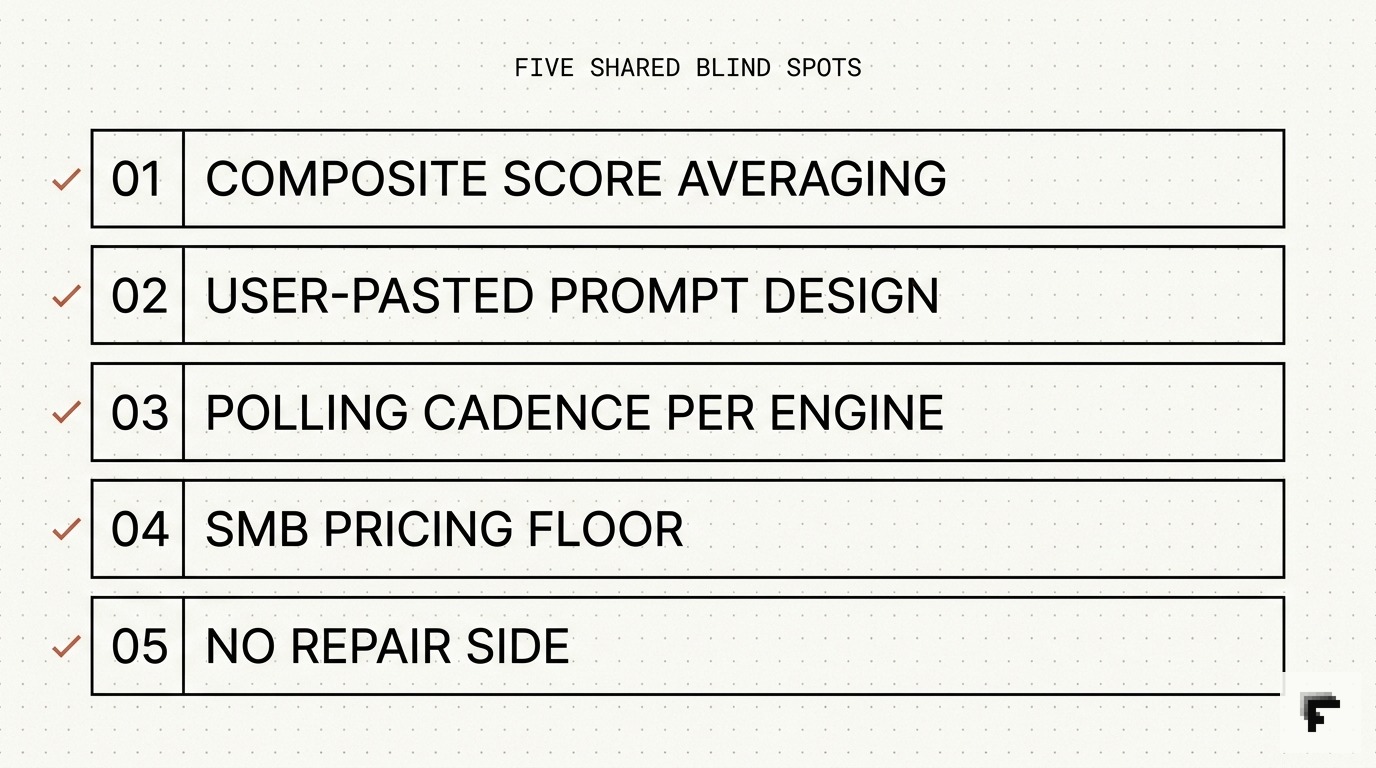
The first blind spot is averaging. Most tools default to a single "GEO score" composited across engines. That number hides the fact that the optimisation work splits cleanly between ChatGPT and Perplexity, with only 11% citation overlap between them (Enrich Labs GEO study, 2026). A composite score of 45 can mean "65 on ChatGPT, 25 on Perplexity" or "25 on ChatGPT, 65 on Perplexity." Two completely different repair sequences for the same number. The tools that surface the per-engine split as the default view are doing the harder, more useful work. The tools that prioritise the composite are easier to demo but worse to use.
The second blind spot is prompt design. Most tools let the user paste their own prompts, which means most users paste the easy ones. "Tell me about [brand]" returns a 90% positive presence score that means nothing. The harder prompts, the buyer-intent shortlist questions ("best property management firm in Dubai", "who builds custom WhatsApp CRMs for brokerages"), are where competitor brands surface in the user's place. Tools that ship with rigorous default prompt sets calibrated to buyer intent outperform tools that hand the user a blank field, but the default-prompt category is small.
The third blind spot is recency versus training-corpus weighting. Perplexity citations refresh weekly because the engine pulls live (Reddit accounts for 46.5% of Perplexity citations on certain query types, ZipTie analysis, January 2026). ChatGPT citations move slowly because the engine relies on training-data cycles that update every six to nine months. A tracker that scores both engines weekly and treats them as the same surface is producing noise on the ChatGPT side and signal on the Perplexity side. Few platforms differentiate the polling cadence by engine.
The fourth blind spot is price-to-value at the SMB end. Pricing for the established platforms sits between $1,500 and $7,500 per month for the productised tiers, climbing into per-seat enterprise contracts above that (WebFX, Stackmatix, Digital Elevator agency surveys, 2026). For an in-house team at a Dubai brokerage with three marketing hires, that is a procurement decision that has to clear a CFO. The category has not yet produced a usable $50 per month tier, and the free alternatives are mostly demo widgets that gate the real data behind a sales call.
The fifth blind spot is the repair side. Every platform measures visibility. None of them ship the foundation work to fix it: the Wikidata QID, the sameAs network, the schema deployment, the AI crawler allowlist, the brand-disambiguation content. The diagnostic-without-remediation gap is where budget gets spent for a year and the score does not move.
The free alternative, and what to look for in a paid one
Foreground's AI Brand Mention Checker is the free version of what the productised tools are charging for. It runs the same five engines (Claude, ChatGPT, Gemini, DeepSeek, Perplexity), the same per-engine score split (not an average), the same competitor co-citation and sentiment surfacing, the same eight buyer-intent prompts calibrated for shortlist queries. No signup beyond email. The diagnostic is identical to what the $1,500 per month tier would return on a single audit.
The weekly open GCC AI brand visibility dataset Foreground publishes makes the same data visible across 50 brands per industry, under CC-BY-4.0, so the per-engine scoring pattern is auditable from the outside. That kind of open methodology is the credibility test worth applying to any paid tool. If a platform will not show you its prompt set or its scoring weights, the score is not auditable, and you should not be paying for it.
For the repair side, the AI Visibility Foundation Fix productises the work the tracking tools all skip. Entity graph, Wikidata QID, schema deployment, AI crawler access, brand disambiguation, day-14 re-baseline. Flat $1,997, deliverables verifiable on completion. The tracking platforms compete on the diagnostic. The remediation work is where the score actually moves.
If your team has the budget for a paid tracker, three criteria narrow the field. First, the platform must surface per-engine scores, not just composites. Second, the default prompt set has to be calibrated to buyer-intent shortlist questions, not echo prompts. Third, the cadence has to differentiate live-retrieval engines (Perplexity, AI Overviews) from training-corpus engines (ChatGPT, Claude). Tools that pass all three are worth the procurement battle. Tools that fail one are worth half of their list price.
Written by Foreground Digital. Start a project →