
Third-party cookies are dead. Four first-party data stacks stress-tested
Third-party cookies are officially gone in 2026, and the first-party-data conversation has moved from theoretical to operational. Four stacks now dominate the market, and each one breaks under different load conditions.
Third-party cookies are officially gone across major browsers in 2026. Chrome's phaseout completed in early Q1, after Safari and Firefox had already enforced restrictions for years. The first-party-data conversation moved from theoretical to operational sometime around Q4 2025, and four stacks now dominate the procurement shortlist for mid-market businesses. Each one breaks under different load conditions, and the difference between picking right and picking wrong shows up in the attribution model within ninety days.
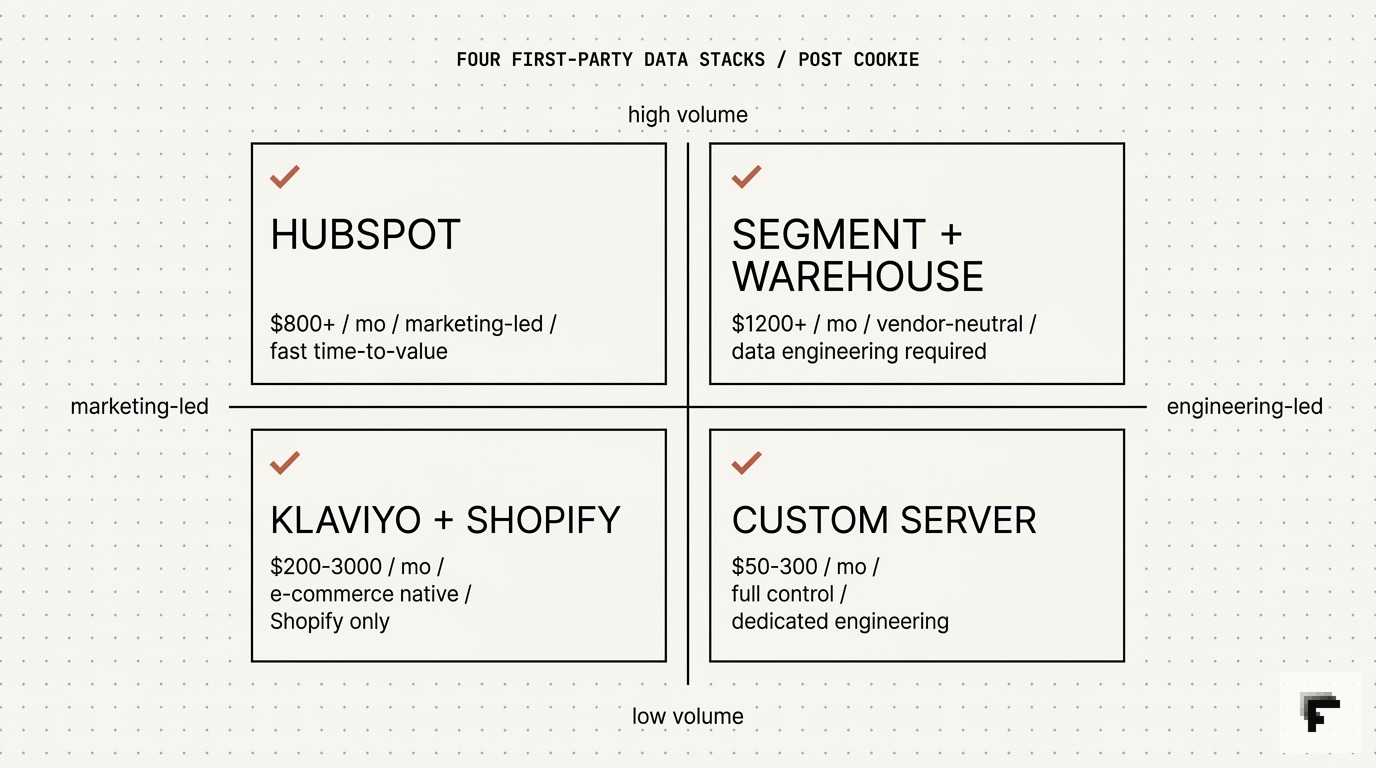
Stack one: Segment + warehouse + reverse ETL. Segment ingests events from web, mobile, and server-side sources, lands them in a warehouse (Snowflake, BigQuery, Redshift), and pushes activated audiences back to ad platforms via reverse-ETL tools (Census, Hightouch). Pricing starts around $1,200 per month at the Segment level and climbs into the $5-15K range for full warehouse + reverse-ETL coverage. Strengths: vendor-neutral, customisable, the warehouse becomes the source of truth. Limitations: requires data-engineering capacity, latency between event capture and audience activation runs 5-30 minutes depending on the reverse-ETL setup. The stack rewards technical teams and breaks for marketing-only teams trying to operate it without engineering support.
Stack two: HubSpot + native integrations. HubSpot's customer data foundation (the HubSpot Customer Hub launched in 2024) treats the CRM as the first-party data layer, with native integrations into ad platforms, email, and SMS. Pricing starts around $800 per month at the Marketing Hub Pro tier and climbs steeply into Enterprise. Strengths: marketing-team operable, integrated reporting, fast time-to-value. Limitations: the data model is opinionated, complex segmentations require workarounds, and the activation latency to Meta and Google can lag the dedicated CDP stacks by 30-60 minutes during peak hours. Fits agencies and mid-market B2B teams that already run on HubSpot. Wrong fit for high-volume e-commerce.
Stack three: Klaviyo + Shopify. For e-commerce specifically, Klaviyo plus Shopify's Customer Accounts has become the dominant first-party stack. Klaviyo manages email, SMS, and audience activation; Shopify's data layer feeds it product, customer, and behavioural events directly. Pricing scales with subscriber count, typically $200-3000 per month for the relevant volume bands. Strengths: e-commerce-native, deep behavioural triggers, activation to Meta and Google in real-time. Limitations: the stack assumes Shopify; bringing in non-Shopify data requires custom integration work that the platform was not designed for. Right fit for direct-response e-commerce. Wrong fit for marketplaces, hospitality, or anything with a Shopify-incompatible commerce layer.
Stack four: Custom server + warehouse. Some teams have rebuilt the data layer on a custom event-collection server (running on Node, Go, or Python), landing events directly in a warehouse, with activation via APIs to ad platforms. The pattern overlaps with the Stape vs native CAPI decision tree but extends past Meta into the full first-party data stack. Pricing is mostly engineering time; infrastructure runs $50-300 per month. Strengths: maximum control, no per-event pricing, no vendor lock-in. Limitations: meaningful engineering investment upfront and ongoing. The stack rewards teams with dedicated data engineering. It punishes teams that thought "we'll build it ourselves" was a saving and then could not staff it.
What each stack breaks under load
Three load conditions surface where the platform picks fail.
High event volume (5M+ monthly events) breaks Segment's per-event pricing and HubSpot's processing capacity. The cost curve on Segment becomes prohibitive past this volume, and HubSpot will throttle the integration without warning. Klaviyo handles the volume on Shopify-sourced events but struggles when non-Shopify data needs to join. Custom servers handle this volume cleanly because the underlying infrastructure scales horizontally.
Complex multi-source identity resolution (the customer is on web, mobile, podcast listener, in-store, and they need to be one identity) breaks Klaviyo because Shopify is not built for the joining. HubSpot handles two or three sources cleanly and degrades past that. Segment plus warehouse handles arbitrary source counts but requires identity-resolution logic the data team has to write and maintain. Custom servers can be designed for this but require dedicated identity-graph engineering.
Real-time activation requirements (sub-five-minute audience updates) break the Segment + warehouse + reverse-ETL pattern because reverse-ETL latency is structurally minutes-to-tens-of-minutes rather than seconds. HubSpot natively, Klaviyo natively, and custom servers can hit sub-minute activation. For most marketing use cases, the five-minute latency is operationally fine. Teams that genuinely need sub-minute (high-velocity flash sales, time-sensitive triggered campaigns) need to know which stack supports it before they pick.
The decision most teams make wrong
The mistake mid-market teams keep making is picking the stack that matches the team they want to have in 18 months rather than the team they have today. Custom servers picked by marketing-only teams produce systems nobody maintains. Segment + warehouse picked by teams without data engineering produces a warehouse with rotting tables and broken reverse-ETL syncs. HubSpot picked by enterprises with high event volume produces a $25K monthly bill for a system the company has outgrown.
The honest decision: pick the stack that matches the team you have, ship clean attribution against it for two quarters, then re-evaluate whether the operating reality has changed enough to justify a migration. The Meta CAPI work, the PMax transparency reporting, and the LinkedIn Predictive Audiences all depend on clean first-party data flowing into them. The platform that delivers that data reliably wins, regardless of which logo sits at the top of the procurement spreadsheet.
Third-party cookies were the easy mode. They were also the bug-ridden mode. Teams adapting fastest in 2026 are the ones treating the cookie phaseout as a forcing function for the data discipline they should have built three years ago, the same discipline that makes Meta CAPI deduplication work cleanly and the same discipline that makes LinkedIn Predictive Audiences converge inside the four-week learning window. The platform is the easy choice. Discipline is where the work happens.
Written by Foreground Digital. Start a project →